On the steps of the Metropolitan Museum for the gala evening on 17 March.
I hope that everyone had an enjoyable spring.
I had a busy time during this period and I visited New York for Asia week for the first time in around 8 years. I flew into Boston and stayed a couple of days there seeing clients and visiting the Museum of Fine Arts (MFA), before taking the train on to New York.
This newsletter focuses quite heavily on Chinese bronzes, as I visited exhibitions at the China Institute and the Metropolitan Museum in New York and have illustrated some works in the entrance galleries at the MFA Boston.
I wish everyone an enjoyable time over the rest of the summer and look forward to seeing some of you over this period.
Best wishes,
Robert Bradlow, July 2025

13 March – Museum of Fine Art Boston (MFA)
This was my first visit to the MFA and on arriving in the front hall, my first glance up the stairs was met with pairs of Chinese ceramics, cloisonné and bronzes flanking each side all the way up.

At the lowest level, sat a large pair of Ming dynasty lead glazed sancai lions, seated on their haunches with their heads slightly raised and barring their teeth. They would have most likely been made in the 16th century and are really well modelled with their mouths wide open. The bright green and yellow glazes have fired particularly well.


The large pair of bronze Qianlong mark and period altar vases really caught my attention. Each were cast in high relief with confronting phoenix amongst stylised scrolling peony. The gilt-bronze handles were also cast in the form of phoenix and the marks were rendered in high relief just below the rims.


At the top of the stairs I turned left and came across a full five piece monumental bronze altar garniture from the Qianlong period. It is rare to see a whole set together and these examples are cast in high relief with confronting dragons flanking a flaming pearl amongst scrolling clouds. The marks of the candle holders and vases are at the base and at the mouth rim on the censer.


On either side of the stairwell landing was a pair of large Ming dynasty Daoist figures. They are each covered with a deep green patina and both stand with their hands clasped in front of their chests. Sotheby’s New York offered a pair similar to the left figure in September 2020, which were dated 16th/17th century.


Moving into the first gallery I came across this unusual Eastern Zhou dynasty bronze standing figure of a youth. Figurative bronzes are really rare and this depicts a figure holding two sticks mounted with jade birds. The jade birds date from the Shang dynasty and are an addition to this figure.


These galleries also contained some fine bronze, wood and ceramic sculpture and I have illustrated three examples below.


One of the main highlights of the MFA was the long ceramics gallery. It was designed in a minimalist, almost Japanese style, which incorporated natural light from windows to one side. The opposite wall has two long cabinets. One contained a number of Qing imperial porcelain.


Two particular highlights were the blue and deep pink sgraffiato ground famille rose vases. Both are beautifully painted with stylised flowers and bear a Qianlong mark to the base. In 2008 the National Palace Museum held an exhibition of 100 pieces entitled: Huali cai ci Qianlong yangcai: Stunning Decorative Porcelains from the Ch’ienlung Reign. In the catalogue, the curator Liao Pao Show refers to Palace records where she accurately dated similar wares to 1743.


The major highlight of the Ming blue and white cabinet on the opposite wall was the magnificent blue and white Chenghua mark and period palace bowl. It is beautifully painted to the interior and exterior with a continuous scroll of magnolia flowers in a rich deep blue colour. The potting of this bowl is superb, as is the clear even glaze and the spacing of the motifs leaving large areas of white ground is particularly effective.


At the other end of the the gallery, the second cabinet contained a number of Song ceramic wares. A particular favourite was the Jin dynasty Jun bowl. It is particularly finely potted and the exterior is covered in deep red and purple copper glaze.


Another great piece from this cabinet was the large Northern Song dynasty Cizhou carved peony vase. The stoneware body was covered in a cream slip, which was carefully carved revealing the grey clay below. The expansive central band acts as the perfect ground for the large scale flowers that are carved in great detail.


The MFA has a great selection of early stone sculpture and two pieces that I would like to highlight are, firstly the large Northern Zhou/early Sui dynasty standing figure of Guanyin, which faces the gallery entrance.
The figure originally came from the Old Stone Buddha Monastery (Gu Shi-fo Si) near Xi’an, Shanxi Province and was sold by Yamanaka and Co to the MFA for $32,000 in January 1915. It stands on a lotus holding a sprig of lotus in its raised left hand. The body jewellery and the drapery folds are particularly well carved.


The other is a pair of Tang dynasty (8th century AD) limestone tomb wall panels of court ladies. They are beautifully carved in high relief with each figure holding a box and scalloped bowl of flowers respectively. They were sold by C.T. Loo to the MFA in March 1937.


The New York Sales
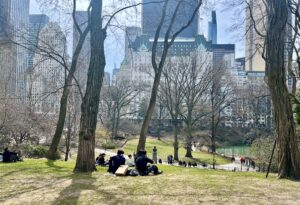
After my day and half in Boston, I took the train down the coast to New York. It had been a long time since I was last there and it felt good to be back in the city. Before looking at some of the highlights of the museum exhibitions and auctions, I thought that I would share some of my images of the city skyline, which I never tire of seeing.


Asia Society – Imperial Treasures, Chinese Ceramics of the Yuan and Ming Dynasties from the Mr and Mrs John D Rockefeller 3rd Collection
The first exhibition that I visited in New York was the Imperial Treasures, Chinese Ceramics of the Yuan and Ming Dynasties from the Mr and Mrs John D Rockefeller 3rd Collection at the Asia Society.
The quality of the exhibits was of the first order and in the foyer outside the gallery were two really memorable exhibits: the large copper-red Hongwu period jar and the Jiajing mark and period wucai fish jar and cover.

The large Hongwu copper-red ‘Three Friends of Winter’ jar was particularly well painted and the colour was bright and generally consistent, which was difficult to achieve in the early Ming dynasty. It was acquired from Albert YP Lee in Montreal in 1970.


The wucai jar and cover is a particularly fine example, painted with unusually bright enamels and depicting carp swimming amongst water weeds and lotus. It was acquired from John Sparks Ltd, London in 1963.


The standout piece to me was the large Yongle period, early 15th century blue and white dragon flask. It is robustly potted with a large flattened hemispherical body rising to a waisted cylindrical neck. It is painted to each side in deep blue cobalt tones depicting a powerful three-claw dragon. His head is slightly raised in a ferocious expression with his mouth slightly open, barring his teeth. These flasks are usually painted with a ground of Indian lotus scrolls, as in this case, or with swirling waves. It was acquired through John Sparks Ltd, London from Christie’s London in March 1967.


One piece that I would have loved to have taken out the cabinet and handled, was the Chenghua period (1465-1487) blue and white dragon jar. One can get an idea of its size from the gallery image above and it would fit rather nicely in the hands. What is so striking about it, is the bright almost electric blue colour of the cobalt and the very bright white ground. Imperial wares in the Chenghua period achieved a level of technical excellence which they had not previously, which also included a thin and even glossy glaze. It was acquired through John Sparks Ltd, London from Sotheby’s London in July 1968.


Another two underglaze blue pieces that I would like to highlight combine a red glaze in two different ways. The first is a Xuande period (1426-1435) waisted ‘dragon’ bowl. It would have originally had a domed cover and is painted to each side with a band depicting a five-claw dragon painted in underglaze copper-red.
The other piece is a mid to late 15th century stem cup painted with celestial horses, winged fish and elephants in underglaze blue, leaping over breaking waves painted in an over glaze iron-red enamel.


Another striking piece in the exhibition is the large Yuan dynasty, mid 14th century blue and white dish, painted to the centre with a prancing qilin. The dish was acquired through John Sparks, Ltd London from Sotheby’ London in June 1967.
The qilin is similar, but in slightly less detail than the example painted to the shoulder of a guan jar in the Schiller Bequest at the Bristol Museum and Art Gallery (see lower left image). It is also quite similar in its overall design to an example in the Ashmolean Museum, but that dish depicts the qilin standing with its head lowered rather than in full flight.
Most of these pieces were purchased by John D Rockefeller the 3rd in London in the 1960s and show a great discernment in acquiring some of the best example of Yuan and Ming Dynasty imperial porcelain.


15 March – Highlights of Bonhams Chinese Ceramics and Works of Art Viewing and Results
I really enjoyed viewing the Bonhams sale which had some really high quality Qing dynasty imperial pieces. My favourite piece and in my view, the item of the season, was lot 24, the Qianlong seal mark and period underglaze blue and copper-red ‘dragon’ vase, tianqiuping. The body is painted with three lively three-claw dragons in copper-red, chasing a flaming pearl on a ground of blue swirling clouds, above breaking waves at the base.


Despite the $400,000-600,000 estimate, the bidding opened at $2 million and with two telephone bidders competing, it quickly rose to $3 million. With buyers premium, it sold for $3.69 million.

The next significant work to sell was lot 27, the Yongzheng seal mark and period pale celadon phoenix and chilong bottle vase. The body is carved with stylised phoenix and chilong amongst floral scrolls below an elegant long neck and lotus petalled mouth. This also had a $400,000-600,000 estimate, which was quickly exceeded and went on to sell for $1.75 million.


One piece that was quite unusual was lot 57, the Ming dynasty, Tianqi period peach-shaped dragon and phoenix bowl. The exterior is painted with a four-claw dragon and a flying phoenix, the interior with peaches.
Part I of the sale achieved $9 million, with a sell-through rate of 82%.


15 March – Sotheby’s Viewing and Results
It was good to be back in the Sotheby’s building on York Avenue, which was probably my last visit to this venue, as the company will be moving in the near future to the Breuer Building, which formerly housed the Whitney Museum on Madison Avenue. The sale was this time held on the 5th floor and was composed of a number of separate viewing rooms.

One of the first pieces that I handled was lot 125, a rare Yongzheng mark and period celadon-glazed hu-form vase. It was being sold on behalf of the Newark Museum and was beautifully potted with two cylindrical handles at the neck and covered in an even pale green glaze. It sold for US$1.07 million (Estimate $600,000-800,000), which was the highest selling lot of the sale.


Another top piece was the Yongzheng yuzhi marked ruby-ground ‘yancai‘ floral cup. It was originally in the collection of George Hathaway Taber (1859-1940), prior to 1935, and later gifted to the Carnegie Museum of Art, Pittsburgh in 1955.
It is beautifully painted predominantly with peony on a deep red ground. The design of the flowers is picked out and painted in pale blue, green, puce, yellow and pink enamels on a white background, which strongly contrasts with the red ground. It sold for $1.04 million against an estimate of $200,000-300,000.


Most of the Ming and Qing dynasty ceramics were on view in a large gallery at the back of the building, with a long viewing table to one side.
One of the largest ceramic pieces in the sale was lot 353, the magnificent Qianlong seal mark and period ruby-ground sgraffiato ground famille rose immortals vase. The sides of the body are painted with two quatrefoils panels of immortals standing beside paulownia and pine trees in a garden with taihu rocks. It sold below estimate at $762,000 (Estimate $800,000-1,200,000).


Of the Ming dynasty ceramics, my favourite pieces was lot 306, the Hongwu period cut down copper-red pear-shaped vase, yuhuchunping. The body is painted with a wide band of chrysanthemum and peony amongst taihu rocks. The colour of the red is really striking and consistent. It sold for nearly ten times the upper estimate at $215,900 (Estimate $15,000-25,000).

(Estimate $15,000-25,000).

One of the finest Dehua figures that I have seen for some time was lot 136, the large standing figure of Guanyin by the renowned 17th century potter – He Chaozong. The figure stands on a round base of breaking waves and holds the billowing drapery with her left had. It sold for $635,000, just over the low estimate ($600,000-800,000).
The sale realised $16.24 million with a sell through rate of 75% by lot.


16 March – China Institute – Eternal Offerings, Chinese Ritual Bronzes from the Minneapolis Institute of Art
On Sunday 16 March I visited the China Institute for the first time in downtown Manhattan, to see the exhibition – Eternal Offerings, Chinese Ritual Bronzes from the Minneapolis Institute of Art.
Most of the bronzes in the exhibition were bequeathed to the Minneapolis Institute of Art (MIA) by Alfred F Pillsbury (1876-1950) in 1950. His father, John S. Pillsbury (1827-1901), co-founded the milling company in 1872 that bears the family name.

Pillsbury purchased his first archaic bronze in 1929 when a number of pieces were coming onto the international market. His collection at the time was regarded as one of the best in the Western world. He hired Bernhard Karlgren, the then director of the Museum of Far Eastern Antiquities in Stockholm, to write a scholarly catalogue of the collection, which was published after his death in 1950.
Nothing had been written about the collection since 1950, when the scholar and curator Liu Yang joined MIA in 2011, but a conversation was started about a ‘bronze project’. This was to result in this exhibition, which opened with much acclaim in March 2023. For the Minneapolis exhibition Tim Yip, the art director of the film Crouching Tiger Hidden Dragon, was hired to design the show (see images below). The exhibition was to tour across America and was shown at the Ringling Museum of Art in Sarasota, Florida and the Asia Society Texas Centre in Houston.


The China Institute exhibition was a much more sedate affair, but the exhibits were still arranged thematically in a number of galleries.
Bronze in Ancestral Rites
This section exhibits a group of Shang and Western Zhou dynasty bronzes that were used in food and wine offerings in ancestral worship ceremonies. This led to the establishment of temples dedicated to this practice.

The bronzes in this section are boldly cast with zoomorphic decoration in relief. One of the classic motifs is the taotie or monster mask. This is a rather mysterious motif, the source of which is still unknown.
For those new to the subject of archaic bronzes, it can be quite difficult to discern the difference between those of the Shang dynasty (1600-1046 BC) and those of the Eastern Zhou dynasty (1046-256 BC).


In fairly simplified terms, bronzes in Western Zhou vessels are more boldly cast than Shang examples and their surface decoration is more dynamic in conception, which creates a strong contrast of light and dark by their high relief.
Shang dynasty examples by contrast are slightly more restrained in their design and the surface decoration is simpler and relies more on incised outlines.


Symbol of Power and Supremacy
The ding food vessel through its role in ancestor ceremony gradually became to be recognised as a symbol of state power and a mandate to rule. They, with other bronzes, would bear inscriptions to their interior in archaic script which recorded historical events and ceremonies.
This early form of script derived from pictograms that was first inscribed onto oracle bones in the Shang dynasty. These were usually the shoulder bones of oxen or the flat underside of turtles.


Bronzes in the Afterlife
At this time, ritual bronzes were used as funeral objects and would be grouped together in the tomb reflecting the social status of the person that was buried there. These would consist of food vessels such as covered ding and gui, and those for wine such as jue and zun. The inclusion of these objects was to create an environment for immortality that reflected those that the person had used in life.


The last three exhibits were notable by their sheer scale. The first piece was a really large Spring and Autumn period, 6th century BC tripod food vessel. It is boldly cast on three cabriole legs with two outward turned handles rising from each side of the rim. There are also three vertical animal forms applied to each side of the body.


The second piece is a large Warring States, 5th century BC water basin. It has four large animal mask-ring handles applied to just below the rim and three horizontal bands of taotie and animal form motifs. The pale green patina is similar to the previous piece.


The last object of the exhibition that I viewed was the large Eastern Han dynasty, 1st-2nd century AD Celestial Horse. It was cast in eight sections, the four legs, the body, tail, neck and head that had all been assembled using types of rivets. There are signs of coloured paint in blue, red and green to its surface.
These bronze celestial horses were inspired by the Central Asian horses that were referred to by this name in China in the Han dynasty. Envoys had brought back stories of powerful horses that worked so hard that they sweated blood.
Emperor Wu (141-87 BC) became obsessed with these horses that he sent diplomats and later soldiers to secure a number, which were to play an increasingly significant military role in the Han dynasty.


After viewing the exhibition, as I was downtown, I decided to view Ground Zero, where the twin towers of the World Trade Center had stood. It was quite a moving experience viewing the water feature with the names of the fallen engraved around it, as well as the large cast bronze mural of that day.


16 and 17 March Christie’s Important Chinese Furniture and Works of Art Viewing and Results
Later that afternoon, I went to view the Christie’s sale. I always enjoy viewing sales at their rooms in the Rockefeller Centre, as the sequence of galleries are so inherently suited for viewing objects. They are also spacious and well lit and the exhibits, such as the furniture, are always laid out with flair.

One of the most striking pieces of furniture that caught my eye was lot 801, the large and very rare 17th/18th century finely carved huanghuali floor screen. One can get the context of its size in the room image of it above. It towers at 214cm high and the centre panel of each side is painted with a Buddhist lion and Daoist immortals respectively. The sides are carved and pierced with panels of chilong.
It had come from the Taipei dealership My Humble House and was exhibited at the Taiwan Antique Dealers’ Association Millennium Exhibition in 2000 in Taipei. There was obviously incredible interest in this and it sold for $2.2 million against an estimate of $100,000-150,000.


Of the imperial Qing porcelain pieces in the sale, the standout item was lot 1104, the magnificent large Qianlong mark and period underglaze blue and iron-red dish. I was able to handle this and it did not disappoint at close examination. The dragons were really well painted in iron-red, with thinner washes of the colour to create three dimensional effects to their bodies. The treatment of their poses to the interior is also quite varied in that one dragon is looking backward, another downward and another’s head is viewed from below.
The iron-red also acts as a very effective contrast to the underglaze blue ground of breaking waves to the centre and the billowing clouds and areas of white to the cavetto. The dragons to the exterior are similarly painted. The dish sold for $2.77 million (Estimate $1.2-2.5 million).


At the other end of the scale, was lot 1098 the small and very rare Yongzheng mark and period famille rose daylily cup. I have included four images of this to give the reader an idea of the decoration in its entirety. The lilies are delicately painted in yellow, white and pale green enamel, illustrating three buds, a bud opening and a fully opened flower. These are all outlined in a thin puce-coloured enamel. It sold at double the top estimate at $1.38 million (Estimate $400,000-600,000).


Another memorable piece from the Yongzheng period was lot 1094, the doucai chicken bowl. The exterior is well painted with a cockerel, hen and chicks amongst garden rocks. The rocks are painted in shaded tones of underglaze blue, which strongly contrast with the overglaze red, yellow, black and green enamels. The interior is painted with a roundel to its base with a similar scene. It sold for $756,000 (Estimate $300,000-500,0000).


Another doucai example that caught my eye, was the lot 869, the rare pair of doucai Kangxi mark and period cups and covers. Each painted with formal designs of bats beside ruyi-form scroll work supporting a peach below a band of hanging pendants. They sold for $100,800 (Estimate $40,000-60,000).
The sale totalled $23.34 million with an 82% sell through rate.


On the way to the Metropolitan Museum from Christie’s, I had to navigate the St Patricks day parade and it was fun to see the various bands and fire and police services marching down 5th Avenue.


17 March – Metropolitan Museum – Recasting the Past, The Art of Chinese Bronzes 1100-1900
I visited the Met twice that day, once to view the exhibition and the other for the evening Asia Week reception. The exhibition was displayed over a number of galleries


In the Frances Young Tang Gallery, I came across two monumental gilt-bronze altar vessels. The first was a large Yongle mark and period tripod censer. The broad hemispherical body is supported by three cabriole legs and rises to two outward-turned handles at the shoulders. There is an incised Yongle mark below the rim, which is also inscribed in Tibetan and Sanskrit. It was originally dedicated to the imperial-sponsored Qutan monastery, a Tibetan Buddhist temple located in Ledu, Qinghai province.


The second piece is a large gilt-bronze baluster altar vase. It is cast with a wide bulbous body, with two ruyi-form handles at the shoulder, supporting two rings. It is attributed to the imperial workshops of the Xuande period and bears the six-character mark in relief below the rim. It was also originally dedicated by the Ming court to the Qutan Monastery.


The exhibition also had a number of really fine quality Ming dynasty gilt-bronze Buddhist figures, brought together from museums in the US and Europe.
One of the most striking of these was the life size figure of pilgrim Sudhana (Shancai Tongzi). The inscription on the lotus petals states that the statue was cast in the imperial workshop for the court in 1641, just three years before the end of the Ming dynasty.
Three other large Buddhist figures with the same inscription are known to have survived, indicating that this figure was most likely part of a larger altar group. One of these figures came up for auction recently at Bonhams Hong Kong (illustrated below) and whilst at Sotheby’s London, I discovered a large gilt-bronze Daoist figure of the same date, in Vienna in the summer of 2010 and sold it that November.
Perhaps a detailed study of these large fine quality gilt-bronze figures of the Chongzhen period should be undertaken, if it has not been done so already.


Another stand out piece was the gilt-bronze figure of Mahamayuri, known in Chinese as Kongque Mingwang (Peacock Wisdom King). He was believed to be a protector against calamities and a dispeller of poisons from snakebites. The detailed casting of the figure and the peacock exemplifies the highest level of craftsmanship achieved in imperial Ming bronzes.


There was some notable juxtapositions in the exhibition, such as the British Museum Yongle mark and period seated figure of Buddha next to the Xuande marked standing one from the Musée Cernuschi in Paris. The treatment of the drapery of the robes is quite different in the two examples. The British Museum example displays a greater degree of naturalism in its treatment, whereas the Cernuschi figure is quite stylised and reminiscent of earlier Tang dynasty (618-906) stone standing figures.


Another element of the exhibition that I appreciated, was the comparison between some blue and white ceramic pieces and their corresponding shapes in bronze, as can be seen by the three illustrations below. In Chinese art there is often a cross over in materials, where one form, such as bronze, jade or lacquer can inspire a similar example in porcelain. Many of the Yuan and early Ming dynasty ceramic forms illustrate this.


Looking at some animal-form bronzes, I particularly liked the three examples of incense burners cast in the form of geese. Each are quite different in spirit and the Yuan dynasty example below, is very life like in that it shows the bird crouching and honking in alarm.

The Ming dynasty example illustrated below left is a little more conventional in that it sits with its mouth open on a lotus lappet base. It is possible that this piece may have been used on a Buddhist altar.
The most unusual and detailed of the three, is the Yuan dynasty example standing with its head facing backward over its body with its beak wide open. The feathers on the wings (which act as the cover of the censer), are cast in relief in great detail. This contrasts with the treatment of the feathers on the body and neck, which are suggested by shallow short linear incisions.


Despite this exhibition looking at works from 1100, there were a number of fine quality archaic bronzes from the Shang and Zhou dynasty on display. The illustration below shows the variety of shapes of these vessels during this period.

My four favourite archaic examples in the exhibition were from the Shang dynasty and first was this monumental wine vessel and cover, pou. The piece exudes power in its size and robust shape – with a wide hemispherical body, its high foot and domed cover. Unusual for the Shang dynasty, the taotie and animal motifs in this case are cast in relatively high relief.


This Shang dynasty zun wine vessel below illustrates the more typical flatter incised relief decoration, which in this example is offset really well with its pale green patina.


The Shang dynasty wine container, fangyi, is, in my opinion, one of the finest early bronzes on display in the exhibition. The combination of its shape, the very high quality of the relief decoration and the even green coloured patina work in perfect harmony.


Another powerfully cast piece, is the large spouted pouring vessel, gong. Each side of the body features part of a large bird motif, which has a downward turned beak just below the spout.


It was really a great opportunity to have seen so many bronzes from different eras in one exhibition and that a number of museums internationally had lent pieces for it. The exhibition runs until 28 September.


10 April – Ashmolean Museum – Handling Session for Young Auction House Specialists and Museum Curators
On the 10th of April we held our third handling session for young auction house and museum staff in the Jameel Study Room at the Ashmolean Museum in Oxford.
We had chosen a varied group of Song, Ming and Qing dynasty ceramics mainly from the Francis Mallett, Herbert Ingram and Gerald Reitlinger collections, which were bequeathed in 1947, 1962 and 1978 respectively.

The format of this handling session was slightly different from previously in that on this occasion we asked each of the attendees to speak about the object in front of them. This was a good way to get each person to look carefully at the object and to give an opinion.

One piece that was an exception to this was the large early 15th century lacquer floral dish. The reverse bears a Xuande reign mark and the interior is really well carved with a mass of flowers including lotus, peony and chrysanthemum. The dense design is set against a yellow lacquer ground and one can see the textile and wood base in the area of the dish that is damaged.

A large cinnabar lacquer floral dish, early 15th century Xuande mark. Purchased with the assistance of the Eric North Bequest Fund, 1981.

We then looked at four pieces of Ming blue and white porcelain from the Frances Mallett collection. My pick from this group is the Zhengde mark and period scholars brush rest shaped in the form of mountain peaks. Each side is decorated with a continuous ruyi scroll and a central panel of Arabic script. The blue is of a very bright even tone and the mark is really well rendered.


We looked at another piece from the Zhengde reign, which was a rather unusual flower vase. Its top is enclosed and pierced with a number of holes to place flowers in. The central part of the vase is square and decorated with circular panels of Arabic script surrounded by scrolling ruyi. There are further panels of script at the base of the long neck. I felt that the square body with the circular foot and neck looked somewhat awkward.


The two Wanli period pieces from the Mallett collection are painted in a deep ‘Mohammedan’ blue colour, the stem cup is painted with a number of scholars seated at a table playing weiqi and standing examining scrolls. The pear-shaped vase is painted with a lively 5-claw dragon and a swooping phoenix.


My two favourite Qing monochromes were the imperial Kangxi peachbloom water pot (taibo zun) and shallow spherical brushwasher (tangle zi). Both of these pieces are from a set of eight wares made for the scholars table. Both have a really bright copper-red glaze that lightens in areas to a an almost pale green.


Another Ming dynasty piece from the Mallett collection was the Wanli mark and period green ground yellow dragon vase. The enamel is painted directly onto the unfired biscuit body, which leaves somewhat uneven patches on the green ground. The design of the panels of dragons and flowers is initially incised into the body prior to glazing.


This wucai vase from the Reitlinger collection was an interesting one to study as it looks as though it had been altered at a later date. Areas of enamel had been scratched off, as can be seen on the plantain on the left image below and it was generally felt that the black enamel on the faces and hats was probably later added.

Gift of Gerald Reitlinger, 1978.


7 May Sotheby’s Hong Kong
On 7 May, four lots of Qing mark and period porcelain that I had consigned on behalf of an Australian client came up for sale at Sotheby’s Hong Kong. Prior to the sale, there was some anxiety by the client that the newly imposed trade tariffs by Donald Trump could potentially compromise the chances of a successful sale. After some discussion with the owner it was decided that the pieces stay in the sale and the decision was the correct one, as they sold very well overall at HK$3.92m against a HK$1.35m low estimate.
I have illustrated the pieces below with their individual prices.


May London and Regional Sales
13 May – Roseberys
The highlight of the Roseberys May sale was two remarkable sets of Imperial Chinese bird paintings by Jiang Tingxi (1669-1732), which were commissioned by Emperor Kangxi (1661-1722). Seven were discovered by Bill Forrest in a London property, which led to a further twelve works being discovered in another property in Dorset.
These paintings are highly detailed studies of birds and to quote Roseberys – Emperor Kangxi commissioned the court artist and minister Jiang Tingxi to produce an encyclopaedic album depicting 360 birds alongside a textual description of each, likely completed in 1721. They were produced in 12 volumes of 30 paintings and were bound together as albums, with corresponding text on the opposing page.
They were acquired by Major Iain Menzies after the First World War and hung in his home at Tadley Court during the 1950s, before he moved to Cannon Hall in 1964. The family were not really aware of the significance or value of the works and this proved to be one of the major discoveries of the London spring selling season. The two groups were sold as two lots as illustrated below and collectively realised £780,480 against a low estimate of £500,000.


15 May – Bonhams
The most significant auctions in London during this season were held by Bonhams in New Bond street, where they offered two private collections and their various owner Fine Chinese sale.
The sale that attracted the most attention was the single owner one of fine Song ceramics of Emmanuel Christofides: Instinct & Knowledge, a Life in the Company of Song Ceramics. Christofides had put together a collection of great quality and variety, a number of which were purchased from David Priestley, the dealer that closely shared his interest in Song ceramics.
Dominic Jellinek gave an illuminating talk on some of the history of the past collectors of these wares, as many of them reflect a roll call of the great English, European and American collectors of the past.

The most surprising result of the sale was lot 16, the Northern Song/Jin dynasty Junyao light blue-glazed bowl. It had been exhibited twice with the Oriental Ceramics Society in 1952 and 1960 and twice in Paris, at the Tuileries, in 1937 and the Musée Cernuschi in 1956. It had also been owned by the esteemed English collector Alfred Clark (1873-1950).
The presale estimate on the bowl was £80,000-120,000 but it sold on the day for just over £1 million.


Another piece to sell well over the estimate was lot 28, the black slip decorated meiping vase. The stoneware vase was originally covered with a black slip which, prior to firing, was carved with peony. The contrasting areas of dark glaze and light ground create a dynamic design. It was estimated £70,000-120,000 but sold for over eight times the mid estimate at £825,900.


The 28 lot sale netted £5.24 million against an £830,000 lower estimate with virtually all pieces selling well over the estimates and with only one lot left unsold. This sale really illustrated the buoyancy of the market for well curated private collections, where many pieces have a significant provenance.
The second single owner sale was: Scholarly Gems from the Collection of Mr and Mrs Gerard Hawthorn. I have picked out a couple of personal favourites below. The 94 lot sale achieved £1.33 million, double the presale estimate, with only 21 lots remaining unsold.


12 & 13 May – Bonhams Knightsbridge
At Bonhams Knightsbridge the highest selling lot in the sale was lot 239, a pair of Japanese Meiji period embroidered panels. These realistically depicted waterfalls in rocky landscapes with trees. They sold for £79,140, around eight times the £8,000-12,000 estimate.

The second highest lot was a Sino Tibetan gilt-bronze figure of Begtse Chen, 18th/19th century. The piece had been purchased in China in the early 20th century. Despite it missing the prostrate figure it would have stood on, it still fetched ten times the mid estimate at £70,250 (Estimate £6,000-8,000).


20 May – Woolley and Wallis
On Thursday 15 May, I travelled down to Woolley & Wallis to view their sale of Fine Chinese and Japanese Art.
Three Qing imperial porcelain highlights of the sale were: the blue and white Jiaqing mark and period double gourd nine dragon vase; the Yongzheng mark and period sacrificial-blue double gourd vase and the Kangxi period copper-red meiping vase.

Lot 127 the Jiaqing blue and white nine dragon vases is beautifully painted with the five-claw dragons writhing amongst scrolling clouds over breaking waves. The vase came from a private collection and was originally owned by Sir Richard Henry Chenevix Trench (1876-1954), who began his career in the military and then served in a political capacity in Hyderabad in India for a number of years. The vase sold for £90,720 (Estimate £10,000-20,000).


Lot 128, the fine Yongzheng mark and period sacrificial-blue double gourd vase was a really great piece to hold in the hand. It is relatively small at only 18.5cm high, but the glaze is a really bright consistent blue and each bulb is quite a lot more spherical than one generally sees on other double gourd vases. It was purchased in Hong Kong in the 1990s and it sold for £132,300 against an estimate of £80,000-100,000.


Lot 130 was the rare Kangxi period copper-red meiping vase, painted with vine branches with squirrels. The copper-red glaze is very bright and consistent, which by the Kangxi period had been technically mastered. The vase had come from the collection of William Cleverley Alexander (1840-1916), who purchased it from John Sparks, London, 9th June 1913 for £30. Woolley and Wallis had sold other pieces from the collection in the past, but the most significant was the Yuan dynasty blue and white double gourd vase, which sold for £2.6m hammer in 2005. This vase sold for £94,500 (£20,000-30,000).


One other piece from the same collection was lot 129, the Kangxi period yellow-glazed fu–shou character ewer and cover. This ewer is so unusual in its shape and would have been complicated to create. The body is covered with a translucent deep yellow glaze and the Buddhist lion finial to the cover is covered in a bright blue glaze. It sold for £44,000 against a £4,000-6,000 estimate.
Their week of sales realised £1.6 million in total.


21 May – Dreweatts
Dreweatts opened their Chinese sale with 49 lots of Chinese and Mughal works of art. One of the highlights of this group was lot 41, the Qianlong period embellished white jade and gilt bronze mounted table screen.
The plaque was inlaid with a design of a bat flying amongst branches of peony and finger citron in jadeite, coral, tourmaline and agate, The gilt bronze frame was finely cast and chased with scrolling foliage and the gilt-bronze reverse panel was finely incised with prunus. It sold for £28,000 (Estimate £5,000-8,000).


Another piece that I was able to handle during the London viewing was lot 177 the 15th-16th century cloisonné lotus censer. The sides are decorated with a striking band of large multi coloured lotus scroll on a turquoise ground. The base was incised with a double vajra. It sold for £38,000 (Estimate £5,000-6,000).


Another memorable piece from the viewing was lot 212 the Song dynasty slip-decorated meiping vase. Here the cream slip is covered over a darker grey body and then carved with panels of chrysanthemum. It was originally sold by Eskenazi Gallery, London in 2003 and it sold this time for £30,000 (Estimate £30,000-50,000).