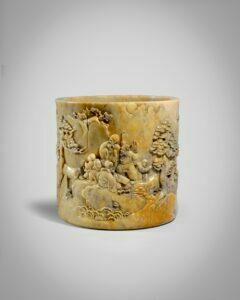
Naturalistically carved depicting the animal resting with its legs tucked under the body, the head turned to the left, with curved horns, the tail sweeping over its haunches, the stone with grey opaque inclusions and brown striations, with a wood stand
Dimensions: 20.5cm high.
Provenance: Formerly a private collection, Queensland, Australia.
Sold on behalf of an Australian private client at Woolley and Wallis, 20 May 2025 (lot 90) for £6,300 (Estimate £6,000-8,000).
Cf. James Lin, The Immortal Stone: Chinese jades from the Neolithic period to the twentieth century, pp.49, no.36, for a late Ming dynasty example.
The water buffalo is the traditional symbol of Spring, strength and tranquillity. Its bucolic aspect evokes the simple and true life in the countryside, and as the reputed mount of the philosopher Laozi, the buffalo has strong Daoist connotations. An important animal in all rice cultivation societies, we find buffaloes depicted in art dating back thousands of years. The Chinese practice of lining the shores of lakes and rivers with bronze buffaloes dates from the Tang dynasty. It is based on the belief that Da Yu, the legendary emperor who is credited with founding the Xia dynasty, (circa 2100 – 1600 BC) and controlled China’s floodwaters, used to place iron buffaloes beside each of his projects. The most famous is the bronze example overlooking Lake Kunming in Beijing’s Summer Palace, which was cast and then personally dedicated by the Emperor Qianlong in 1755.