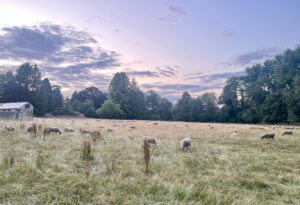
Grounds of MONA Museum, Hobart, Tasmania, February 2025.
I hope that everyone had a restful winter.
I had a busy time during this period and in December I visited Paris for their Art D’Asia sales.
Over this time I also visited a number of museum exhibitions, which included the Great Mughals: Art, Architecture and Opulence at the V&A, the Yaoi Kusama exhibition at the National Gallery of Victoria in Melbourne. I also visited MONA – the Museum of Old and New Art in Hobart, which I really enjoyed.
I wish everyone an enjoyable spring and look forward to seeing some of you at the Asia Art sales in London next month.
Best wishes,
Robert Bradlow, April 2025.

Paris Auctions
10 December – Bonhams Cornette de Saint Cyr – Art D’Asia
I travelled to Paris for the second time last year and my first port of call was to view the Art D’Asia sale at Bonhams Cornette de Saint Cyr at their Avenue Hoche offices.
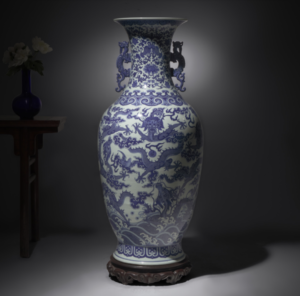
The highlight of their sale was lot 38, a magnificent large Qianlong seal mark and period turquoise ground famille rose dragon vase. I had viewed it a month earlier in London during Asian Art in London and it was beautifully painted with a lively five-claw iron-red dragon and a smaller pink one amongst scrolling lingzhi-form clouds. The base was painted with an iron-red seal mark reserved on a turquoise ground.
The vase had belonged to William Dederich (1872-1926) who was an English business man who made his fortune supplying equipment for the railways in England in the 1890s. He helped finance Sir Ernest Shackelton’s 1914 Antartic expedition. The vase was inherited by his daughter.
The vase sold for €1,161,600 against an estimate of €300,000-500,000.


11 December – Christie’s Art D’Asia
Meanwhile over at Christie’s, I had a few pieces consigned from a Hong Kong client, two of which sold well (see below).


In the same sale, I had consigned a Qing dynasty suit of ceremonial armour that had been owned by Admiral Colthurst Holland (1844-1922), who was a Royal Navy officer who served as Commodore in Charge at Hong Kong from 1896 to 1899. It sold over the €6,000-8,000 estimate for €11,340.


Notable highlights from the sale included lot 53, a rare blue and white Xuande mark and period (1426-1435) blue and white ‘fruit and flower’ hexafoil bowl. It was really well painted with sprays of fruit and flowers including peach, lotus, chrysanthemum and pomegranate. It sold for €201,600 against an estimate of €100,000-150,000.


There were two interesting inscribed Kangxi monochrome pieces in the sale. The first was lot 71, the Langyao bottle vase, the base with an inscription to the Yiwei year of the Qianlong period (1775). It had been sold three times at Sotheby’s in Hong Kong in May 2005, October 2014 (HK$4.36m)and October 2016 (HK$1.87m). It had also been exhibited at the 1935-1936 Royal Academy International Exhibition of Chinese Art. It sold for €126,000 (Estimate €60,000-80,00). It is interesting to note the price changes in the last ten years.


The second piece was lot 73, the rare Kangxi mark and period ‘sacrificial blue’-glazed bowl. The base also bear a 7 character hall mark Yuci Chunyi Tang Zhen Cang (Imperial gift in the collection of the Hall of Sincerity). There is a similarly marked blue bowl in the Percival David Collection at the British Museum. This example sold really strongly for €214,200, over ten times the mid estimate (€15,000-20,000).


A personal favourite from the Buddhist gilt-bronze section was the Densatil circa 1400 Tibetan gilt-copper alloy plaque depicting goddesses as musicians.
Densatil was a monastery that was developed from 1198 onward at a place called Pakmodru overlooking the Yarlung Tsangpo River. It was famous for its eighteen great stupas that were erected between 1170 and 1570. If you look at the black and white image below, you can see similar panels of musicians on the bottom tier of this stupa. Sadly the monastery was destroyed in the 1960s and pieces are scattered throughout museums and private collections around the world. This lot sold for €453,600, well over its €150,000-250,000 estimate.


Sotheby’s New Paris Premises
Whilst I was in Paris, I visited Sotheby’s new premises on the corner of Rue Faubourg-Saint-Honoré and Avenue Matignon. The move is only a couple of blocks down from their previous saleroom opposite the Palais de L’Elysée.
The building was previously owned by the Bernheim-Jeune Gallery, which was founded at the end of the 19th century by Alexandre Bernheim and became a significant gallery selling and supporting avant guard artists at the time such as Impressionists: Claude Monet, Édouard Manet, Pierre August Renoir and modern artists such as Pablo Picasso and Amadeo Modigliani.

When one enters the front door, there is a large lobby and reception desk that leads into the main ground floor galleries. These areas are lit by a series of floor to ceiling arched windows that give the rooms a light an airy feeling.

Whilst I visited, Sotheby’s had their Treasures sale on view throughout the ground floor and the most important works were exhibited in the central gallery. This area is at the heart of the building and opens up to a glass atrium that gives the space additional natural daylight. The design of this is reminiscent of a radiant brilliant cut diamond, which was perhaps Sotheby’s intention.


The various walls on the ground floor galleries are movable, which allows this space to become a saleroom for 200 people.


At the back of the ground floor galleries is an unusual octagonal viewing space known as the Tribuna Gallery. I assume that this must have been used by the Bernheim-Jeune Gallery as an intimate viewing space for small exhibitions. The combination of the wood panelled walls and black marble floors is rather elegant.

The first floor is dedicated to exhibiting luxury items for private sale. This is a large space for this and represents a departure for the company from previous salerooms. With 30% additional space than previously, this premises easily allows for this large L-shaped gallery which, when I was there, consisted of an exhibition on skateboards, hand bags and jewellery.


With its shift in direction to selling a greater percentage of luxury goods, such as jewellery, wine, watches, bespoke trainers, NFT’s and contemporary art, Sotheby’s has, for some time, been carefully targeting wealthy younger buyers. With the generational transfer of wealth and the change in traditional auction buying habits, this is not that surprising. What is quite interesting is that the choice of building (an ex retail gallery space) is now clearly part of the equation and Sotheby’s future strategy.


The second floor L-shaped galleries mirror the first floor and allows for spacious auction viewing spaces. Whilst I was there, the African and Oceanic sale was on view and the white walls and pale wood parquet floors really offset the many dark wood sculptures.


As Sotheby’s now only hold one live Asian sale in Paris in June and a Chinese one in London in November, the upstairs hallways was where they viewed their online China 5000 years sale. This did seem a little cramped, but I am sure that for their June sale this year, this will be held in the main viewing areas.


What was quite unusual whilst viewing in the Asian galleries was being able to look through the the windows into the atrium to see what was happening in the galleries at all levels. This sort of transparency within a building is not something that I have seen architecturally before.
What I like about the building is this slight sense of unpredictability in that you are not sure what you are going to find around the next corner from week to week. I wish them all the best in this space.

14 December – Alastair Gibson Fine Asian Art Auction
On the 14th of December Alastair Gibson held his second twice yearly auctions and I helped consign a group of Chinese export porcelain from the Mujintang Collection. This was the second group, as the first had been offered in December last year.
This group featured mainly European designs, some of which were rare and unusual, such as the Miracle of Zaandam, Don Quixote on horseback and an Iberian market stand. This group comprised 75 lots, which all sold with a total of £60,000 hammer, against a £21,500 low estimate.


2 January – Victoria and Albert Museum Exhibition – The Great Mughals: Art, Architecture and Opulence


On 2 January I visited the Victoria and Albert Museum to see the Great Mughals exhibition. The Mughal era lasted from around 1580 to 1650 and spanned the reigns of three emperors: Akbar, his son Jahangir and his grandson Sha Jahan. Akbar’s grandfather Babur, who had walked with his men in winter from Herat to Kabul in Afghanistan, established the Mughal dynasty after invading the Delhi sultanate in 1526. Babur was descended from Genghis Kahn the founder of the Mongol empire – the term ‘Mughal’ is Persian for ‘Mongol’.
I have focussed only on a small group of mainly three dimensional objects from the exhibition, some of which are of Chinese origin or influenced Chinese art.


Yongle period (1403-1424), British Museum.

The first object is the beautiful pale celadon jade tankard that is inscribed to Ulugh Beg, the Timrud ancestors to the Mughal emperors and his title forms the main decoration to the rim. This form of tankard was based on an earlier metal ware form, which would have included a cover. I have illustrated this and an early Chinese Ming dynasty blue and white example.


Mughal inscribed wares on early Ming dynasty porcelain are very rare and are historically of interest as they record the history of imperial ownership.
It was nice to see the white Yongle monk’s cap ewer again, as I had discovered it in Stockholm in 2012, where it had belonged to an Indian taxi driver and had been passed down the family. It sold for £265,000 in November of that year and is on loan from the Aga Kahn Museum in Toronto.


The finest jade vessel in the exhibition was the inscribed white jade cup that belonged to Sha Jahan and is dated to 1657. The quality of the workmanship is of the highest quality, as is the pure white stone. The detailed carved ram’s head terminal opens out to a thinly carved petal bowl and rests on a flower form foot.


13 February – MONA, Museum of Old and New Art, Hobart Tasmania.
On 13 February whilst travelling in Hobart, Tasmania I visited MONA, the Museum of Old and New Art. This was my second visit, as I had been at its opening in January 2011.
MONA is a private museum that was founded by a Hobart local – David Walsh, a mathematician who made his fortune by developing a mathematical algorithm that he applied to online gambling. In one interview Walsh stated he felt that that nothing is created by making money from gambling. That is, it is somewhat of a zero sum game where one person loses and one wins. Thus he wanted to create something lasting with the money that he had made.


David Walsh purchased Moorilla Winery in 1995 from the Italian textile merchant Claudio Alcorso who had set up the winery in 1958 on Frying Pan Island on the Derwent River at the Berriedale Peninsula, northeast of Hobart. Walsh opened the Moorilla Museum of Antiquities in 2001 with mixed success. He closed it in 2007 and appointed the architectural firm Fender Katsalidis to undertake a $75 million redevelopment of the site.
I remember David Walsh working with Sotheby’s Australia colleagues in the early 2000s to acquire a number of Australian and international artworks intended for the museum. In 2007 he hired Mark Fraser, the managing director of Sotheby’s Australia to help him oversee the project and he became its first director. He also hired two other Sotheby’s colleagues – Jane Clark as the senior research curator and Nicole Durling, who was to become the Director of Collections and Exhibitions.


On the day of the visit, we decided to travel by ferry from Hobart on one of two camouflaged catamarans (known as Mona Roma I and II) that are owned by Walsh. These are also hired out for private parties and corporate events.

The entrance to the museum is somewhat unusual in that if coming by road, you have to cross a tennis court to get to it. This is located at the old Alcorso house, designed by the Australian architect Roy Grounds, which has a protection order on it.

Because of the protection order and to keep the integrity of the grounds at Moorilla, it was decided to excavate into the sandstone cliffside and create a subterranean museum on three levels. This is a somewhat unique approach which precluded windows and thus any natural light into the galleries.


After descending in a glass lift or via a spiral staircase to the third lower level, one arrives at the Void Bar which has a sign above the bottles – Cocktails, Pizza, Emptiness. The start of the journey down the rabbit hole had begun.. To the right is a long passage flanked with a 30ft sandstone wall where people congregate to sit.


I popped into the gallery on my left and came into a space that seemed like a cross between a casino and a bordello, with rich floor to ceiling red curtains, psychedelic patterned carpet and ornate gilt-wood furniture upholstered in leopard pattered fabric. I have not really encountered a space like this in a museum before, which encourages visitors to sit and enjoy the art at their leisure.
The main overriding themes of the museum are that of sex and death – the basic human urges of desire (of sex) and fear (of death). There are a number of works that do not necessarily follow this theme, as it is after all a museum that has been created by one man (with help) who has also bought what he likes.


Another unconventional aspect of the museum is that it takes a somewhat non didactic approach to its displays – it does not have any gallery labels next to any works, or boards explaining the themes of any of the galleries. The reasoning behind this is to allow the viewer the freedom to experience and interpret the artworks intimately without having to ‘follow the instructions’ that have been set out.
On arrival at the museum, you are encouraged to download their app, so that when you stand near a work, a summary of it can be obtained. The viewer can also listen to a curator or get a more detailed description of the work, the artist and content by clicking on the Art Wank icon. The viewer is also allowed to vote whether he or she loves or hates the work.


Another rather tongue-in-cheek aspect I liked at the museum, was the ability (for a few dollars) to name a gallery, which would stand until the next donor replaced it. I believe that this subverts and pokes fun at the idea of museum sponsorship and the role that money plays in cultural social status.


A number of the following works illustrated below are part of an exhibition entitled Namedropping, which consists of 250 works over 15 galleries. The exhibition examines ‘the nature of status and why it is useful. Is it just cultural or something deeper.. a form of essentialism – where things have a spirit that transcends their material state?’
One enters a man cave lined with pine walls on which hangs photographs of cars, framed gold discs and letters of the famous from the past and present. In the centre of the room there is a card table with 8 piles of chips as if the players have just gone for a break.


One of the most engaging and beautiful works in this exhibition is Brett Whiteley’s The Naked Studio. This is the first time I had ever seen this work and it did stop me in my tracks. It is a large scale diptych which is almost five metres long overall. In the centre of the work is a nude model (possibly Wendy Whiteley) lying on a couch. She is surrounded by paintings and drawings of nude figures and the walls and floor are of a deep almost violet blue that gives an overall unity to the work.


One of my favourite spaces in the museum, was the gallery that housed Richard Wilson’s 20:50, an installation work of steel and oil. From the image below it is quite difficult to read, but essentially you walk into a area lined with steel sheets around 4 foot high which is surrounded with black oil right up to the lip of the sheets.

The gallery is composed of a series of square and rectangular grids to the ceiling, walls and floor. The former forms skylights and together with the lighted floor, gives the gallery an other worldly airy quality. The best view of the exhibit is from a balcony above where the reflection of the space off the oil is really effective.


There are a number of internal tunnels and passages in the museum linking various galleries. A great deal of care and attention has been given to these. One stops at the carved sandstone walled passage with a frosted glass ceiling and peers up at the appearing and disappearing feet. The up lights at ground level highlight the beautiful pink and beige tones of the stone and accentuates the carved patterns across its surface. It did beg the question, can architecture become art installation?


One striking installation at Mona is Randy Palumbo’s Grotto, which is composed of blown glass and polished aluminium, which reflect low resolution videos of catastrophic weather and geological events. One is encouraged to sit on the silver upholstered cushions and enjoy the experience of this space.


One of the works that was imprinted on my memory from my last visit was Sidney Nolan’s Snake. It is composed of 1620 framed water-based paintings on paper that was painted between 1970 and 1972. When one steps back from the individual semi-abstract paintings, the impression of a snake is clearly seen.


A recurring symbol that one sees throughout the museum and on its website and publications is the x and + symbols. According to David Walsh this represents a combination of multiplication and addition, symbolising the cycle of life driven by sex and death, and themes like redemption, increase, and multiplication.

I enjoyed my second visit to MONA and felt that I could have spent a second day there as there is really too much to see just on a single day’s visit. I was curious to see what my impression would be on this second visit and it still struck me as the most unique museum that I have been to. With the addition of regular summer and winter music and arts festivals (Mona Foma and Dark Mofo) David Walsh has created a significant international destination point in Hobart.


24th February – Bonhams Australia – The Cheong Family Collection
On 24 February I viewed a selection of pieces from the Cheong family collection that had been sent from Sydney to their office in High Street Armadale.
Norma and Eugene Cheong met in Australia and married in Hong Kong. They moved to London in the 1960s. Eugene bought a number of Martin Brothers stoneware pieces and Norma, being influenced during her time in Hong Kong, started to collect robes and porcelain. Most of the pieces date from the 19th century and she had a particular interest in pieces from the Guangxu period (1875-1908).
Norma did follow the London auctions, but it seems that most of her purchases were made from dealers such as Bluett and Sons, Spink and Son and Linda Wrigglesworth.

My two personal favourites amongst the ceramics was lot 33, the Yongzheng mark and period yellow-glazed cup and lot 52, the Qianlong/Jiaqing Yanghe Tang hallmarked famille rose ‘fu-shou’ dish. Whilst composing this newsletter, the collection has just sold for A$2.7m and I have attached prices to the images below.


19 February – Yayoi Kusama Exhibition at the National Gallery of Victoria
On 19 February I visited the Yayoi Kusama exhibition at the National Gallery of Victoria. It was quite a revelation to me as I had not really encountered much of her work previously except for some of her pumpkins that I had seen come up at auction.

Part 1 – Early Work
The exhibition was divided into two parts between her early and later work and each was set in different parts of the building.
Some of her works on canvas of the early 1950s are powerful depictions of twisting rope forms. This period was a difficult time for Kusama as she was troubled with Japan’s conservative nationalism, memories of the Second World War and her parents’ opposition of her becoming an artist.


Her paintings then became more abstract in her Infinity Net series, which was inspired by her observations flying over the Pacific Ocean on her way to the US.


Kusama designed a number of dresses for herself which led to her establishing the Kusama Fashion Company in 1969. Her designs ranged from relatively conventional styles to radical designs, which were stocked by retailers in New York and sold at her own boutique on the corner of Sixth Avenue and West Eighth Street.


Part 2 – Later Works
Kusama has struggled with mental health for a large part of her life and on her return to Japan in 1973 this deteriorated. In 1977, she found a doctor in Tokyo who was using art therapy to treat mental illness in a hospital setting. She checked herself in and eventually took up permanent residence in the hospital. She has been living there ever since, by choice and her studio is situated nearby.
On her return to Japan, she was largely forgotten and had to build her career again from scratch. This got a boost with the success of the Japanese Pavilion at the 1993 Venice Biennale, where she resided (in colour co-ordinated magicians attire) in a mirrored room filled with small pumpkin sculptures.


Kusama first saw a pumpkin as a teenager on a visit to a seed-harvesting nursery. She went to pick one and it began to speak to her in an animated manner. She started painting pumpkins around 1946 and she adopted it as a recurring motif in her art. She likened painting them to Zen mediation, where she would ‘confront the spirit of the pumpkin, forgetting everything else’.
In the late 1970s she returned to painting pumpkins, initially yellow and black and black and white dotted examples. These transformed into sculptures and infinity mirror rooms. Kusama’s use of multiple dots stems from childhood hallucinations, where she experienced visual disturbances involving dots that she later used to express infinity, the cosmos, and personal experiences.


vinyl inflatables, plywood, fans, dimensions variable.

One of the exhibits that I enjoyed the most was the works from the My Eternal Soul series. In 2009 she vowed that she would paint 100 works in 18 months. The series was finally finished in 2021, where she had painted close to 900 works, which was an incredible achievement for someone from their early 80s to their early 90s.
The canvases display such a wide variety of forms and bright colours that work individually or en masse as this display shows.


At the end of the exhibition everyone was given a sticker of a poppy to attach onto the walls or furniture of the last gallery, thus including the audience in creating a fun and interactive space.
I went to the exhibition with very little preconceptions or much knowledge of her work. My experience, especially in her installation rooms, was one of sheer visual joy of colour and light and how this affected me as the viewer.
Yayoi Kusama once stated that if it was not for her art, she would have committed suicide long ago. I believe that we are all the beneficiaries of her living a long and productive life making her art.