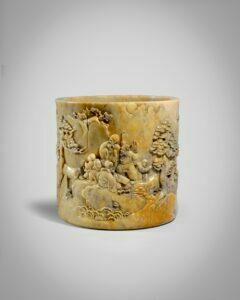
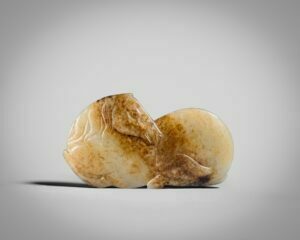
Welcome to the first instalment of the private treaty selling via the website.
In this first series, I will be offering ceramics and works for art from the Song to the Qing dynasty.
For further images, condition reports and prices please contact me by email on or by telephone: +44 7365 080508.
Pieces will be offered strictly on a first come first served basis.
A blue and white ‘Eight Horses of Muwang’ dish, Qing dynasty, Kangxi period
The interior painted with the eight horses frolicking in an open field below birds flying among a willow tree and rocks.
Dimensions: 22 cm (8 3/5 in) diameter.
Provenance:
Raymond and Victoria Tregaskis, Sydney, Australia.
Private Collection, Australian Capital Territories, purchased from the above 2006.
The motif of the Eight Horses of Muwang often appears on Chinese ceramics and represents the legendary King of Mu, the fifth emperor of the Zhou dynasty (1023-983 BC) who rode a chariot pulled by eight divine horses on a journey to paradise to taste the peaches of immortality.


A pair of blue and white ‘dragon and carp’ dishes, Qing dynasty, Kangxi Period
Each painted to the interior with a dragon rising out of breaking waves and chasing a flaming pearl amongst gusts of wind, below a band of braking waves and prunus to the sloping rim, the reverse with a twin fish mark.
Dimensions: 21.5 cm (8½ in)
Provenance:
Private Collection, Montreal, Canada.
The symbolism of the dragon and the carp in Chinese art is based on the carp leaping over the ‘Dragon Gate’ to become a dragon. The pairing of these symbolises triumph over adversity and can also represent significant improvement in social status, especially through hard work and passing examinations.


A large blue and white phoenix and peony jar, Qing dynasty, Kangxi period
the rounded sides painted in deep underglaze blue tones, depicting two phoenix flying amongst trailing peony scrolls.
Dimensions: 31cm high (with wood cover).
Provenance:
Clive Brans Antiques, Perth, Australia (according to label).
The Phoenix (Fenghuang): Known as the ‘king of all birds’ and a symbol of high virtue, grace, and peace. It only appears in times of great peace and prosperity and is often associated with the empress and feminine power (yin), though it can represent both male and female.


An archaistic turquoise-glazed flambé hu-shaped vase, Qing dynasty, 18th/19th century
The baluster ribbed body, rising from a spreading foot to an slightly everted rim, the shoulders with applied horned beast masked handles, covered in a glaze of lightly crackled turquoise and violet splashes, the foot unglazed.
Dimensions: 26.5 cm (10.1/2 in) high.
Provenance:
English Private Collection.
This vase has a striking combination of shape and glaze, where the violet splashes create a dynamic contrast with the turquoise colour, especially where it has run down the vertical grooves.
Compare with a similar turquoise-glazed vase, 18th/19th century, that was sold at Sotheby’s New York, 26 September 2023, lot 1117.


A Qingbai moulded ewer and cover and a small lobed box and cover, Song dynasty
The shoulder and base with bands of moulded lotus lappets, with loop handle and short spout, below a band of incised lines below the neck and at the rim, the box moulded with flower heads within lobed petal-rimmed borders.
Dimensions: 8 cm (3 1/8 in) high and cm ( in) diameter
Provenance:
Sotheby’s London, 10 May 2017, lot 200.
The Collection of John E Bodie OBE (1930-2023).

John E Bodie OBE (1930-2023)
John had begun collecting art in the mid 1950s after being invited to the country home of the property developer Harry Hyams. After the purchase of his home he made contact with Peter Vaughan of John Sparks Ltd, who helped him fill two niches on either side of his fireplace with Chinese porcelain. This was the beginning of John’s fascination with this field.
He was to go on to buy some important imperial pieces at auction from Sotheby’s and from London dealers such as William Clayton Ltd, Bluett & Sons, Roger Keverne and Marchant.


An unusual Jizhou tea bowl, Song dynasty
The rounded sides rising from a short straight foot to a straight rim, decorated with a deep brownish-black glaze to the exterior and honey toned amber glaze to the interior
Dimensions: 11.6 cm (4.5 in) diameter.
Provenance:
David Baker Oriental Art Ltd, London, 26 November 2015.
The Collection of John E Bodie OBE (1930-2023).
This Jizhou bowl has a rather unusual glaze combination, with an amber interior and a black exterior. Additionally, at the interior base, there is also an unusual glaze effect combining, pale blue, white and amber colouring.


A Jian ware conical teabowl, Song dynasty
decorated to the interior and exterior in a flecked brown glaze, falling irregularly above the foot.
Dimensions: 12.7 cm (5 in) diameter.
Provenance:
Christie’s South Kensington, 1990s.
The Collection of John E Bodie OBE (1930-2023).


A Yaozhou celadon glazed conical cup, Song/Yuan dynasty
The steeply curved sides rising from a short strait foot to a slightly flared rim, covered in an even olive green glaze
Dimensions: 12.9 cm (5 in) diameter.
Provenance:
Hartl Gallery, Munich, 2001.
Private Collection Munich.


A large gilt-splashed tripod censer, Qing dynasty, 18th/19th century
The bombé sides rising from three cabriole legs and applied with two animal mask handles, fitted rosewood stand.
Dimensions: 24.5 cm (9 5/8 in), wide, 2196 g.
Provenance:
Lawsons Auctioneers, Sydney, early 2000s, part of a deceased estate from a family that purchased the piece in the 1920s.
Dr Peter Brown Collection, Sydney, Australia.