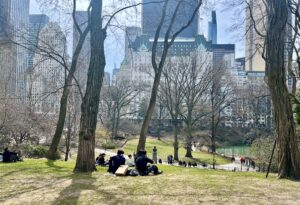
My La Grande Jatte moment on the banks of the La Garonne, Toulouse, July 2025.
Dear Clients and Friends,
I hope that everyone had an enjoyable and restful summer.
I began the season by visiting the sales in Paris in June and enjoyed handling some fine examples of Chinese art being offered at auction.
I vetted the third Treasure House Fair and despite there being limited Asian pieces, I was able to take a sneak peek at the stands before they officially opened.
On 31 May this year the V&A East Storehouse opened in Stratford. It is one of the first museum stores to open its doors to the public. I looked at some of the displays and discuss their approach to making a larger part of the Museum’s collection accessible to the public.
I also visited the Fitzwilliam Museum again with a view to organising a future tour and I review some of the exhibits in their Chinese Gallery .
Over the autumn period, I will be giving the annual Sir Alan Barlow lecture at the Ashmolean Museum on Friday 31 October and will be viewing the sales during Asian art in London.
As mentioned previously, during this period, I will also be offering my first group of pieces in a series of online private treaty sales of Chinese ceramics and works of art, so I look forward to engaging with some clients in this and meeting you over this period.
Best wishes,
Robert Bradlow, September 2025
Paris Sales – Printemps Asiatique


9 June – Christie’s Paris, Viewing and Results

My first port of call in Paris was Christie’s on rue Matignon to view their Art d’Asia sale and I managed to view the highlight of the sale, lot 26, the Xuande mark and period ‘dragon’ stem bowl. It had been consigned from a French noble family and was finely painted with two lively five-claw dragons on a pale blue ground of swirling waves. It sold over the €300,000-500,000 estimate for €882,000.


Another high flyer that was viewing adjacent to the above piece was lot 83, the rare and large Ming dynasty 16th/17th century gilt bronze figure of the seated Buddha Shakyamuni. As with so many sculptures, the face is one of the most important elements of a piece and in this example the figure’s countenance is very peaceful with its eyes cast downward in deep contemplation. It is quite unusual in a figure of this height (80cm overall) to have its original lotus base and its hexagonal plinth. It wasn’t such a surprise that it sold above its estimate for €315,000 (Estimate €150,000-250,000).


Somewhat less expensive, was lot 120, the Jiajing mark and period wucai ‘crane’ jar. It was brightly painted in underglaze blue and yellow, green and iron-red enamels depicting cranes, beribboned ruyi and Daoist emblems. Despite the two hairline cracks to the rim and one to the base, the jar realised €119,700 (Estimate €10,000-15,000.


However, my favourite late Ming piece in the sale was lot 6, the small Wanli mark and period blue and white ‘scholar’ dish. It combined a free, spontaneous style of painting with a deep blue cobalt colour on a very white ground. The glaze was thin and slightly glossy and the mark was very well painted. It was a lovely piece to hold in the hand and wasn’t really surprising that it sold for €21,160, multiples of its €4,000-6,000 estimate.


A notable Qing dynasty detailed enamelled piece, was lot 138 the small Qianlong seal mark and period Yangcai ruby-ground sgraffiato ‘lotus’ jar. Again a diminutive piece, but in a quite different spirit to the above. This piece depicts the high Qing imperial formal style painting, with stylised lotus and formulaic bands of ruyi at the neck and petals at the foot.
The ground is painted in a ruby enamel and the foliate design is painstakingly etched into the surface. It is a real tour de force of patience and quality workmanship. It again sold over its €20,000-30,000 for €107,100.


Another Qianlong imperial piece worth mentioning is lot 18, the blue and white ‘lanca’ stem cup. Stem cups in this Buddhist style featuring Tibetan characters and meandering lotus scrolls are fairly common, but I highlight this piece as it was far better quality than many that I have handled. Again the deep blue colour contrasted well with the very white ground. The artist who painted this had particular flair in painting the motifs and the spacing of them across the surface of the piece. It had previously been offered by Marchant in their 1984 catalogue Qing Mark and Period Blue and White. This time it was offered from a European private collection and it sold for €32,760 (Estimate €6,000-10,000).


An unusual pair of dishes from the same European private collection was lot 14, the famille verte green-backed examples that were painted to one side with warriors and scholars. The reverse of each dish was unusually covered with a pale green translucent enamel.
They had once belonged to Alfred and Ivy Clark and had been exhibited at the 1951 Oriental Ceramics Society Enamelled porcelain of the Manchu Dynasty (1644-1912), with one dish also in their later 1964 Arts of the Ch’ing Dynasty exhibition.


This collection also featured lot 16, an usual pair of Kangxi blue and white square-section ‘warriors and horsemen’ vases and covers. They are based on a European form and their flat surfaces work as successful vertical formats to depict figures in court scenes and warriors on horseback.
A similar pair of vases in the Rijksmuseum were exhibited in Professor Christian Jorg’s 1997 book, Chinese Ceramics in the Collection of the Rijksmuseum Amsterdam. Here he states that the scene probably illustrates scenes from Yang jia jiang yanji (The Command Troops of Yang Ye’s family) by the Ming dynasty author Yong Damu. They sold for well above their €6,000-10,000 estimate at €21,420. All ten lots from this private collection sold and most, well above their estimates.
The 146 lot sale realised €4.94 million with a 72% sold through rate by lot.


10 June – Sotheby’s Viewing and Results


Sotheby’s sale was a larger offering of 247 lots and featured 19 lots of late Ming dynasty imperial wares from the London dealer Marchant, to commemorate their 100 years of being in business. Marchant’s were one of the first Western dealers to recognise the significance of late Ming dynasty wares and held their first exhibition – Chinese Blue and White – Wan Li to K’ang Hsi in 1980, which featured a number of Wanli period (1573-1620) wares.
The highlight of this group was lot 137, the very rare Longqing mark and period (1567-1572) wucai ‘dragon and phoenix’ wine cup. Marked pieces from this short reign period are rare and the bright enamels combined with the free, spontaneous painting style contributed to it selling well over the €150,000-200,000 estimate at €330,000.


One of my personal favourites from this group was lot 125, the large blue and white Jiajing period (1522-1566) ‘dragon’ bowl. The decoration is painted in deep ‘Mohammedan’ blue tones and painted in a rather comical style that is reminiscent of the large fish bowls and jardiniere’s of the era. Two dragons each chase a flaming pearl on a cloud scroll ground above a band of ruyi at the foot.
What I like about this piece is the loose style of painting and the combination of its size and the deep blue contrasting with its white ground. It sold for €95,250 (Estimate €60,000-90,000 ). The following lot – 126 featured a similar bowl in iron-red (both illustrated together below). This type of bowl is probably rarer in iron-red, but I personally feel that this example is more successful with the painting under the glaze, in blue, rather than on top of it in iron-red.


Another favourite from the sale was lot 136, the Wanli mark and period wucai ‘dragon’ square zun-form vase. At 34cm high, this is the smallest version of this type of vase, (largest is around 73cm and middle size is around 47cm high).
This vase would have been made by luting a number of slab-formed sections together and would have therefore been quite a time consuming piece to make. The contrast between the underglaze blue and bright overglaze enamels works well despite the denseness of the design. The applied animal mask handles and the sharp outlines of the piece gives it a certain robustness. It sold for €44,450 (Estimate €35,000-50,000).


The stand out imperial Qing porcelain piece in the sale was lot 161, the large Qianlong mark and period blue and white globular ‘dragon’ vase, tianqiuping. The Sotheby’s catalogue note refers to the Chinese scholar – Gang Baochang’s work Mingqing ciqi jiangding (Appraisal of Ming and Qing porcelain), where he states that this rounded form of seal mark is among the earliest of Qianlong marks applied on a handful of pieces made between 1737 and 1747.
The tianqiuping (celestial globe vase) with its wide rounded body is the perfect format to paint a continuous design of six five-claw dragons in different poses amongst a meandering lotus scroll. One of my favourite poses, is the view of the dragons head from underneath, which is rarely seen on pieces (see illustration below) and is a rather witty interpretation of this mythical animal.
This form in blue and white and painted with dragons, was first seen in the early Ming dynasty during the Yongle reign (1402-24), but the shape and spirit of the painting is very different. The band of waves at the rim is closely related to those of the early Ming dynasty.
It sold well over its €80,000-120,000 estimate at €698,500, but it should be noted that the neck had had been damaged and was finely restored.


The most stand out work of art in the sale was lot 10, the important 11th/12th century Dali Kingdom seated gilt-bronze figure of Avalokitesvara. The Dali Kingdom was an independent dynastic state of the East Asian Bai people and was situated in Yunnan in South Western China from 937 to 1253.
Figures are more commonly seen standing, with long slender bodies (see below) and are quite distinct from the Buddhist styles of neighbouring China and Tibet and represent a link with artistic styles with South East Asia. They were seen as a state icon and often referred to as Acuoye Guanyin or ‘Luck of Yunnan’, being associated with good fortune.
This eleven headed bodhisattva sits in the meditative ‘noble posture’ sattvaparyankasana pose and the hands of the figure’s sixteen arms hold various associated attributes. It sold at just over double the low estimate at €508,000 (Estimate €250,000-350,000).
The sale realised €5.99 million with a sold through rate of 72% by lot.


10 June – Bonhams Cornette de Saint Cyr Viewing and Results

On Tuesday 10 June I visited Bonhams Cornette de Saint Cyr at their Avenue Hoche premises.
On entering their first floor galleries, the first room that I came across held their star lot of the sale, lot 146 – the very rare and large pair of Qianlong period bronze bixie. My first reaction on seeing them was one of surprise, as they, with their deep green patination and their rather angular forms, appeared, for a moment, to be more like an installation of contemporary art, than something steeped in Chinese history.
Stone bixie have, since the Han dynasty (206 BC to 220 AD), been associated with important tombs and ‘spirit roads’, where they were used to line the path to these graves. The bixie is a zoomorphic mythical creature with wings of a bird and elements taken from a lion and tiger. Their function has traditionally been to guard the tomb and ward off unwanted spirits. This pair were inspired by stone examples from the Six Dynasties (265-589 AD) and one can see this in an example from the Southern Liang dynasty (502-557) (see centre image below). However these bronze examples are a slightly more restrained version of this, despite their sheer size, open mouths and powerful limbs.
Bonhams had found two very close contemporary comparisons in stone – one flanking the stairs from the Marble Pagoda (Qingjing huacheng ta) at the Lamaist Western Yellow Temple in Beijing (Xihuang si), which was built by the Qianlong Emperor and completed in 1782. It was build to commemorate the death of the Sixth Panchen Lama in 1780 after he had visited Beijing two years earlier to celebrate the Emperor’s 70th birthday. The other example (illustrated in Osvald Siren’s Histoire des Art Anciens de la Chinese, vol III, which located the sculpture in front of the Zhihuihai Temple at the Summer Palace (Yiheyuan) in Beijing. These comparisons strongly suggest that these bronze examples would have been imperially commissioned.
It is really difficult to value pieces like this where there is very little to compare them to and thus €300,000-500,000 was a sensible presale estimate. At the sale, they were contested for around 15 minutes by two telephone bidders, one represented by Asaph Hyman, (Global Head of Chinese Ceramics and Works of Art) and the other by Mark Rasmussen, (International Director of Indian, Himalayan & Southeast Asian Art) to finally sell to the latter for €3.32 million hammer (€4.06 million with buyers premium).
They had originally belonged to the renowned German post war financial broker Rudolf Münemann (1908-1982) and according to the vendor, had been purchased from a branch of the Drummond family in the 1960s. This sale represents how strong the demand is for real rarities with an imperial affiliation, despite a market that in general is in recovery mode.


The second most significant lot in the sale, was lot 1, the magnificent and highly important Song/Yuan dynasty Ge mallow-shaped brush washer.

It was marketed as a single lot sale and it belonged to the visionary Italian jewellery designer, fashion model and philanthropist – Elsa Peretti (1940-2021). Peretti transformed Tiffany & Co with her sculptural design pieces of jewellery and Vogue magazine described her as ‘arguably the most successful woman ever to work in the jewellery field.’ Her most notable designs were the Bone Cuff bracelet, the Open Heart, Bean and Diamonds by the Yard.


I am not aware that Peretti owned any other examples of Chinese art, but it is noteworthy that she owned one major piece of minimalist Ge ware. The simplicity of its shape and the colour and crackle of the glaze obviously appealed to her aesthetic. Ge washers are generally more common without feet, so this example was thus rare in its conception.
It sold on the day for €1.1 million hammer (€1.37 million with buyers premium) (against its estimate €1.2-1.5 million estimate. Its slightly muted response at the sale may have partly been because one of the legs had been repaired and perhaps the market favours examples without feet.


Another highlight of the sale was lot 130, the Qianlong period very rare imperial silver-inlaid zitan and cloisonné enamel table. Cloisonné inset tables are rare in Chinese furniture, especially in zitan wood. The upper surface of the elegant fan shape was inset with a similar shaped cloisonné panel, decorated with stylised phoenix and lotus on a pale blue ground. The frame surrounding this was finely inlaid in silver, as were the sides. The front and sides were also inset with smaller cloisonné panels, with a central phoenix, flanked by bats and with archaic dragons to the spandrels. It sold for €127,400 (Estimate €100,000-150,000).


Lot 150, the Qianlong mark and period yellow-ground green-enamelled ‘dragon’ vase, was a rare example in this shape and the incised five-claw green dragons stand out dramatically against their bright yellow ground. It sold well beyond its €120,000-150,000 at €241,700.
The four sales at Bonhams Cornette de Saint Cyr that week realised a total of €7.39 million.


11 June – Some Memorable Sculpture at the Guimet Museum
The following day I visited the Guimet Museum with a friend and really enjoyed many of the sculptural exhibits. The Museum was hosting the exhibition: Angkor Royal Bronzes: Art of the Divine and the front gallery featured the large 11th century Cambodian bronze reclining figure of Vishnu Anantashayin.

Adjacent to this bronze was another monumental Cambodian stone figure group of the Naga on the Causeway of the Giants. Balustrades of mythical serpents like this were to be found on the causeways leading to temples like Angkor Thom and Preah Khan, particularly the ‘Giants’ Causeway’ at Preah Khan. This example is made in horizontal sections that are then joined together.

One of the most striking sculptures at the Guimet is the life size Liao dynasty (907-1125 AD) Yixian sancai-glazed pottery figure of a Luohan. This figure is part of a group of 8 figures that were discovered in caves south of Beijing in Yi County, Hebei province in the early 20th century. The other examples are in the British Museum, two in the Metropolitan Museum, New York and museums in the US, Canada and Japan.
This group of figures look as though they have been sculptured from life, given their individual features. I has also been suggested that they were also portraits of notable contemporary monks.


In the same semi-circular gallery, I saw this Song (960-1279)/Jin (1115-1234) dynasty polychrome wood figure of a seated Guanyin. One can see a strong influence of Tang dynasty (618-906 AD) examples, in the treatment of the drapery and the tilted head, which is a rare feature in these type of works.


One of the rarest and possibly the largest archaistic bronze known is the Shang dynasty (1600-1050 BC) elephant-form wine vessel, zun that is located in the early bronze and ceramic gallery. It is missing its cover and would no doubt have been cast in various parts and soldered together.
It is a wonder of early bronze technology and it has powerful presence in part due to its size, but also to the fine detailed decorated surface, which comprise a large taotie mask to each side of its body and various archaistic scrolls and the smaller tight spirals – leiwen (thunder pattern) ground. However, with all its detailed decorative surfaces, it still manages to convey the spirit of the animal.
I first saw it in the Royal Academy 2012 exhibition Bronze and it really held its own amongst some of the top bronzes of the world from various eras and civilisations.


One of the most unusual and striking pieces in these galleries was the group of four Tang dynasty terra cotta and plaster relief plaques. They originate from the Xiuding temple pagoda, in Anyang County, Henan province. Similar relief plaques can be seen on the exterior of the building (see images below).


Of the Tang dynasty pottery sculpture, one particular group of four polo players was particularly well modelled, with quite a degree of detail in the saddle cloths and the figures robes. The colour of these figures is quite bright and it is possible that they have been re-coloured.


25 June – Treasure House Fair
On 25 June I undertook the vetting for the third instalment of the Treasure House Fair at the Royal Hospital, Chelsea.
As mentioned previously, I always enjoy undertaking this, despite the limited amount of Asian art on view, because it is fun getting the opportunity to have a sneak peak of the various stands before they open to the public the following day.

The first stand that we looked at was Laura Bordignon’s, who specialises in Japanese works of art. I particularly liked her various inlaid bronze birds and animals, which are so life like and were made by the swordsmiths who turned to sculpture when the wearing of swords was outlawed during the Meiji period (1868-1812). A particular favourite was the wrestling tigers as seen below.

One aspect of Japanese art that I do like is its anthropomorphism that is depicted in painted images or sculptural carvings. In the case of the silk Oshi-e panel below, the artists has depicted a procession with grasshoppers, crickets, praying mantis and flying ants, with a palanquin being supported in the centre. This represents a journey of a feudal lord from Edo to an outlying district, where he is protected by his samurai.
The rare Oshi-e technique, (which means ‘pressed picture’) is where elements of an original drawing are cut out and transferred onto thick paper. This gives them a greater three-dimensional appearance.


One of the most magnificent pieces of Chinese craftsmanship at the fair was the George III style Chinese export Huanghuali and ebony cabinet, circa 1765. It is very rare to find English style furniture in Chinese woods and made for European export. The real highlight of the piece is the reverse painted mirror astragal doors.
In most furniture of this style, these doors are usually made of glass, revealing shelves within and their contents. These reverse paintings are done with a great degree of skill, depicting figures in interiors, river landscapes and birds on flowering branches. We voted this as the best example of Asian art at the Fair this year.


One contemporary art stand that really stood out was A Lighthouse Called Kanata. They deal in Japanese contemporary art from ceramics, to glass, stone and paintings.

Personal favourites were the tactile and smooth white forms or Kan Yasuda’s (1945-) white marble Tenpi. The gallery were very kind in allowing visitors to touch and run one’s hands over the surface of this and other of his works. It is almost impossible not to when looking at his works. Another great piece was the bright blue glazes of Yoshiro Kumara’s (1946-) vessel in blue glaze. It combines a wonderful rounded form with a bright blue glaze that deepens to a darker blue mid way down the vase.


I always enjoy the wide variety of colours and shapes in contemporary ceramics and glass on Adrian Sassoon’s stand. Every year, he usually has a number of works by Felicity Aylieff, some of which can by very large and are commonly seen painted in underglaze blue.
She works in the ceramic city of Jingdezhen in China and this year her works consisted of beautiful vases that were painted in overglaze enamels and the rounded forms (reminiscent of tianqiuping (celestial globe)) were particularly pleasing as seen below.


I have vetted the fair with Caroline Blunden for a number of years since its Masterpiece days and we always enjoy the day which includes an enjoyable lunch given by the organisers.


10 July – Visit to V&A East
On 10 July I visited with the Victoria and Albert Museum East, which had recently been opened in May at the Queen Elizabeth Olympic Park, part of the 2012 Olympic site in Stratford, East London.
Walking from the train station was quite an eye opener, as I had not seen this part of London since the Games and was surprised at the development of apartment buildings, restaurant and leisure facilities that had sprung up since this time.


The V&A East building had been used as a media and broadcast centre during the Olympics. Entry is free with pre-booking and I waited in the coffee shop for some friends to arrive.

The ground floor area is open plan reminiscent of the High-Tech architectural style, (championed by Norman Foster and co-founded by James Stirling alongside Richard Rogers) characterised by exposing the building’s structure and internal services, such as pipes, as an aesthetic element, making them ‘visible’ and ‘working’ parts of the design.

The building was refurbished by the firm of architects – Diller Scofidio + Renfro. On their website, they explain that their brief was ‘to outfit the building for 250,000 objects, 350,000 books and 1,000 archives from the V&A’s collection of fashion, textiles, furniture, theatre and performance, metalwork, ceramics, glass, sculpture, architecture, paintings and product design’.
And that ‘visitors are invited on a behind-the-scenes journey that uncovers and demonstrates how and why objects are collected, how they are cared for, conserved and researched and how they help make sense of our past, present and future as part of exhibitions and public programmes’.

At the top of a flight of stairs, one arrives at a three story central collection hall, the centre of which has a large window in the floor with a view to the storage shelves below. At first sight, one is taken a bit aback by the space and its various levels with such an array of objects.


What I like about the concept of the storage facility here is the unusual juxtaposition of objects and that they are not neatly categorised by date or country. Thus one’s journey through the shelves is not predictable at all and at one moment one can delight at a group of 18th century Chinese jades neatly stored in vertical pigeon holes and the next, come across a massively oversized double bass, a painted oil drum that was decorated for the 1975 Glastonbury music festival or the Torrijos carved and painted ceiling from Toledo, central Spain circa 1490.


Some might argue that there is not really enough pieces on show to provide the depth of view in any particular subject. However, the Museum provides closer access to objects through a study centre that allows for the personal viewing and handling of requested objects, which needs to be booked at least two weeks in advance.


There is also a viewing platform over a conservation area, where one can observe pieces being cleaned and conserved.

One of the major highlights at the V&A East is Pablo Picasso’s Two Women Running on the Beach, a monumental stage cloth designed for La Ballets Russes production of Le Train Bleu in 1924. It was based on a 1922 work by Picasso during his Neoclassical Period after World War I and was enlarged over 30 times by the Russian theatre artist Alexander Shervashidze in just 24 hours. It impressed the artist so much with its accuracy that he signed it with his name. The work hangs in its own gallery on the lower level.


On balance, I do believe that the V&A East is successful in giving access to the public to see a greater percentage of pieces that it has in store and that the space is well ordered and brightly lit. It is often the complaint of collectors (considering donations) or the general public, that museums, like an iceberg, only show a small percentage of what is actually there.


1 August – Visit to The Fitzwilliam Museum
On 1 August I visited Cambridge to undertake some planning for a possible future tour and possible handling session of the Fitzwilliam Museum Chinese collection.
During the visit I was really struck by the magnificence of the original entrance hall. Most visitors these days enter via a modern side entrance and come across this during their visit. The grandness of this vast two story hall is created by different coloured marbles used in the columns, pediments and the central balustrade staircase. This is heightened by a liberal use of gilding to highlight the numerous Classical revival architectural elements.

The entrance and the museum itself was designed by George Basevi (1794-1845), but he was not able to see his design completed as he tragically fell to his death from Ely Cathedral tower in 1845. Charles Robert Cockerell (1788-1863) was then appointed to complete the building and he replaced Basevi’s design for three domes with a single one, the interior of which one can see below.


On entering the first Asian gallery, one is confronted with a large Song dynasty polychrome wood figure of Guanyin, seated in the ‘royal ease’ (lalitasana) pose. The figure would originally been brightly coloured with layers of paint and gilding and its eyes are inlaid with polished glass or stone.


Gallery 28, houses some of its finest examples of Chinese ceramics and works of art from the Shang to the latter part of the Qing dynasty. Featuring early bronzes and pottery to fine porcelain from the Yuan, Ming and Qing dynasties. There is also a group of Japanese ceramics from Haniwa pottery to later Arita porcelain. The adjacent gallery has a group of Korean ceramics from the Gompertz collection.

This gallery houses one of my favourite Yuan dynasty blue and white guan jars, that was bequeathed to the Museum by the renowned collector of the early to mid 20th century – Oscar Raphael. Raphael split his bequest between the British Museum and the Fitzwilliam.
I am not aware of any other jars in Western collections with this rare design, but I believe that there is one in the Palace Museum, Beijing and one possibly in the Wuhan City Museum. What I particularly like about this jar is the deep blue colour that is used for the painting. It is highly likely that a very rich source of Middle Eastern cobalt must have been used, rather than the local cobalt with a higher manganese content which gave pieces a more grey appearance.
Coupled with this is the very high quality of the painting and deftness with which the painter organised the design over the three-dimensional surface of the jar, thus creating a continuous ‘canvas’. Additionally the very white body once fired in a clear glaze, acted as the perfect ground to offset this design.


Next to the jar is an unusual blue and white stand of the same period, painted with two bands of lotus and a central band of pierced quatrefoils panels. It is a very rare form and I am not aware of any others in museum collections. However, similar shards have been at the Heishuicheng site in Inner Mongolia and the Truk Ulan site in Indonesia. The Fitzwilliam Museum website suggests that its function was as a stand for large dishes.

Purchased at Sotheby’s London with the Cunliffe Fund and the University Grant, July 1967.

The collection also contains two pieces which are painted with the unusual Makara mythical animal. It is a legendary sea creature from Hindu mythology and is one of the zodiac animals in Hindu astrology. It is not surprising to see them depicted on imperial porcelain as they have been regarded as guardians and protectors of gateways, thresholds to temples and to throne rooms. The Makara is a zoomorphic animal resembling a dragon, with the front part of the body of an elephant or deer and the back part of an aquatic animal of a fish or a dolphin.
In both examples depicted, a lotus scroll issues from its mouth. The painting in the Xuande example is more typically early Ming in terms of its dark cobalt blue colouring and the variation of application, with the thicker areas of paint breaking through the glaze, commonly known as ‘heaping and piling’. The painting of the Kangxi period example is much more even in its thin application and is thus of a much lighter tone of blue that is mostly translucent. The head of this figure is also much closer to that of a dragon.


Of the Qing dynasty imperial porcelain a large part of this is from the Reginald Cory Bequest, given in 1936. Reginald Cory (1871-1934) was the third son of John Cory (1828–1910), who had established successful shipping and coal exporting businesses. He was to inherit Dyffryn House, just outside Cardiff and he also became a successful entrepreneur in the business. His collecting focussed on Qing dynasty imperial wares.
The wide and varied collections at the Fitzwilliam are partly due to the director at the time – Sir Sydney Cockerell (1867-1962), who had the practice of bringing in experts and hiring them as honorary keepers. Oscar Raphael, was one such keeper, who also acted as a voluntary assistant keeper at the British Museum.
Raphael advised Cockerell on Cory’s bequest in 1934 and helped the Museum acquire some the finest pieces from the collection. Where there were pairs, these were split between the British Museum and the Fitzwilliam, such as the Kangxi mark and period famille verte ‘Birthday’ dish, the Yongzheng mark and period famille rose chrysanthemum dish and Qianlong mark and period ‘bat and peach’ bowl below.


A large Kangxi period famille verte jar and cover and two yenyen vases, part of a five-piece garniture, made the news in January 2006. The unfortunate 42 year old visitor – Nick Flynn took the front stairs and half way up them, he changed his mind. As he turned to go back down, he did not realise that his shoe lace was undone and he lost his balance and fell on to the stairwell windowsill. As there was no hand rail to break his fall, he hit one vase which, with a domino effect, smashed the others.


Penny Bendall, a conservator who worked for the Royal Collection, was contacted to restore the three vases. This was a real challenge as she had to figure out amongst the hundreds of broken pieces which shards came from which vase. the first vase to be hit, on the right of the sill, sustained the most damage and smashed into approximately 120 big sherds. I attended a lecture some years later where Bendall explained how she underwent the painstaking restoration and the photographs below are a testament to her work. For those interested, the full story of the restoration is on the Fitzwilliam website: https://stories.fitzmuseum.cam.ac.uk/kangxi-vases-conservation/