Brilliance: Ming Dynasty Ceramic Treasures from the Palace Museum, 1368-1644
I visited the Hong Kong Palace Museum for the first time on 30 November last year and went with some clients from Australia.
The most interesting exhibition on this visit was the Ming Dynasty Ceramic Treasures from the Palace Museum. On entering the first gallery, there is a horizontal semi-circular cabinet with four early Ming dragon dishes.

One of the rarest example is the Zhengtong period (1436-1439) underglaze blue and iron-red enamelled dish. The underglaze blue five-claw dragon is beautifully painted in two tones of blue and perfectly fills the circular space within which it is confined. The iron-red and waves effectively contrasts with the dragon and acts as a perfect backdrop, giving the appearance of the dragon in three dimensional space.

Another rare dish from the Interregnum period is the blue and white example from the Tianshun period (1457-64). Here the dragons are winged and again ‘fly’ over swirling breaking waves. In this dish, the waves are made more dramatic by covering the whole dish. Additionally, there are five dragons in the cavetto below the classic scroll rim. This could be one of the first representations of a central dragon surrounded by smaller ones.

The next two blue and white dishes date from the Zhengde and Jiajing periods respectively and illustrated the development of this motif through the Ming dynasty.
In the first example, the central dragon appears almost to be running on its two hind legs. The decoration of this with the lotus scroll and the surrounding band are rather crowded and does not leave much area of white ground.
In contrast, with the Jiajing period (1622-66) example, the central dragon’s body is elegantly curved and the deep blue colour of the decoration contrasts really well with the greater areas of white ground.


The next two pieces clearly illustrate how difficult it can be to fire the cobalt blue successfully in the earliest reign of the Ming dynasty – The Hongwu period (1368-98).
The floral bowl is beautifully painted with lotus, peony and chrysanthemum in a deep blue colour and the flowers, especially to the interior are really well spaced in their band. The cobalt blue on the large Hongwu period dish by contrast has fired to an almost dark grey colour, but the central roundel of chrysanthemum are naturalistically painted ‘growing’ out of the ground.


One of my favourite pieces in the exhibition was the Hongwu period copper-red painted yuhuchunping vase. Copper-red is notoriously difficult to fire without discolouration. In this example the red is perfectly fired and the quality of the decoration of the ‘Three Friends of Winter’ is first rate. The neck and rim is also intact, which one does not see with many examples.


The cabinet with a Yongle period (1403-24) Longquan celadon grape dish and a blue and white contemporary example illustrates an interesting comparison between the two kilns and how the artists decorated the interior in the different techniques of carving and painting.


Another favourite in this exhibition is the very rare and large Ming dynasty Longquan celadon yenyen (phoenix tail) vase. The colour of this vase is a bright green, which is so sought after by collectors and the peony scroll and ruyi band are particularly well carved.


Another rare form in the exhibition was the Yongle period blue and white floral basin. This shape is based on an earlier, 14th century Middle Eastern brass or glass form and it is likely that this example would have been made for the Middle Eastern market. The design of the decoration however is Chinese with bands of flowers to the interior and exterior and a thin band of breaking waves to the rim.


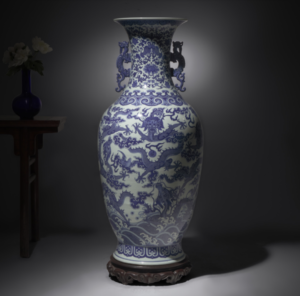
I believe that one of the most successful designs in early Ming imperial porcelain is the large dragon tianqiuping (celestial sphere) vases. The large compressed rounded body makes for the best ‘canvas’ to paint a large dragon writhing across its rounded surface. The dragons on these types of vases are often painted with great spontanaiety and have lively facial expressions with wide eyes and their mouths open. I think that of all Chinese ceramics, this is the one that I would like to own.


There were a number of monochromes in the exhibition, the most notable of which were the Xuande mark and period celadon-glazed foliate dish and the copper-red bowl. In both examples, the form and colour are perfectly unified through top quality potting and a consistent application of glaze.


A stand out piece from the Interregnum period of the 15th century was the blue and white dragon zun vase. It is painted in deep blue tones with horizontal bands of lively winged dragons. The interior of the rim is painted with a row of long ascending leaves – a design rarely seen on this part of a vessel, which is particularly striking.

Taishun period (1436-64).

The exhibition also included a number of pieces from the Chenghua reign (1465-87). During this short period, porcelain production reached its peak of quality and refinement in terms of potting, painting and purity of material, which fires to a creamy off white colour.
Two notable doucai examples were the lotus stem cup and the cup decorated with grapes. Comparing the enamels of Chenghua pieces to those of the 18th century copies, the colours of the former are slightly muted and not as bright as the latter. The colour of the fired porcelain in the 18th is also quite a bit whiter.

Two stand out blue and white examples of the Chenghua period painted with the Three Friends of Winter are the stem bowl and the dish. The interior base of the stem bowl depicts the pine tree, prunus and bamboo within a central roundel and then each individual tree to the exterior. The dish depicts a central garden rock to the centre with the Three Friends delicately painted around it.


Of the later Ming wares, my personal favourites were the wucai wares of the Wanli period (1572-1620). Of particular note was the tall pear-shaped vase painted with mandarin ducks on a lotus pond. The colour combination between the underglaze blue and the bright over glazed enamels works particularly well in this example.


The wucai decoration is particularly effective in the Wanli period dragon and phoenix dish, where the underglaze blue is a deep dark blue colour.


Broad sweep exhibitions of a whole dynasty are not an easy undertaking when trying to accurately portray porcelain production of 14 emperors over nearly 300 years. I believe that this attempt has been successful by the quality and breadth of the exhibits, as well as the inclusion of pieces rarely seen, such as a dou-shaped vessel with its cover intact, the Arabic and Persian inscribed circular box and cover and the mid 15th century blue and white dragon zun vase just to name a few.


Whilst I was at the Palace Museum, Hong Kong I also saw their Passion for Collecting exhibition, which featured a number of Hong Kong collectors and donations that they had recently made to the museum. I have listed a number of these below and have illustrated the pieces that they have given.


I really enjoyed the day at the Palace Museum, Hong Kong and I believe that it is a wonderful addition to the cultural life of Hong Kong.