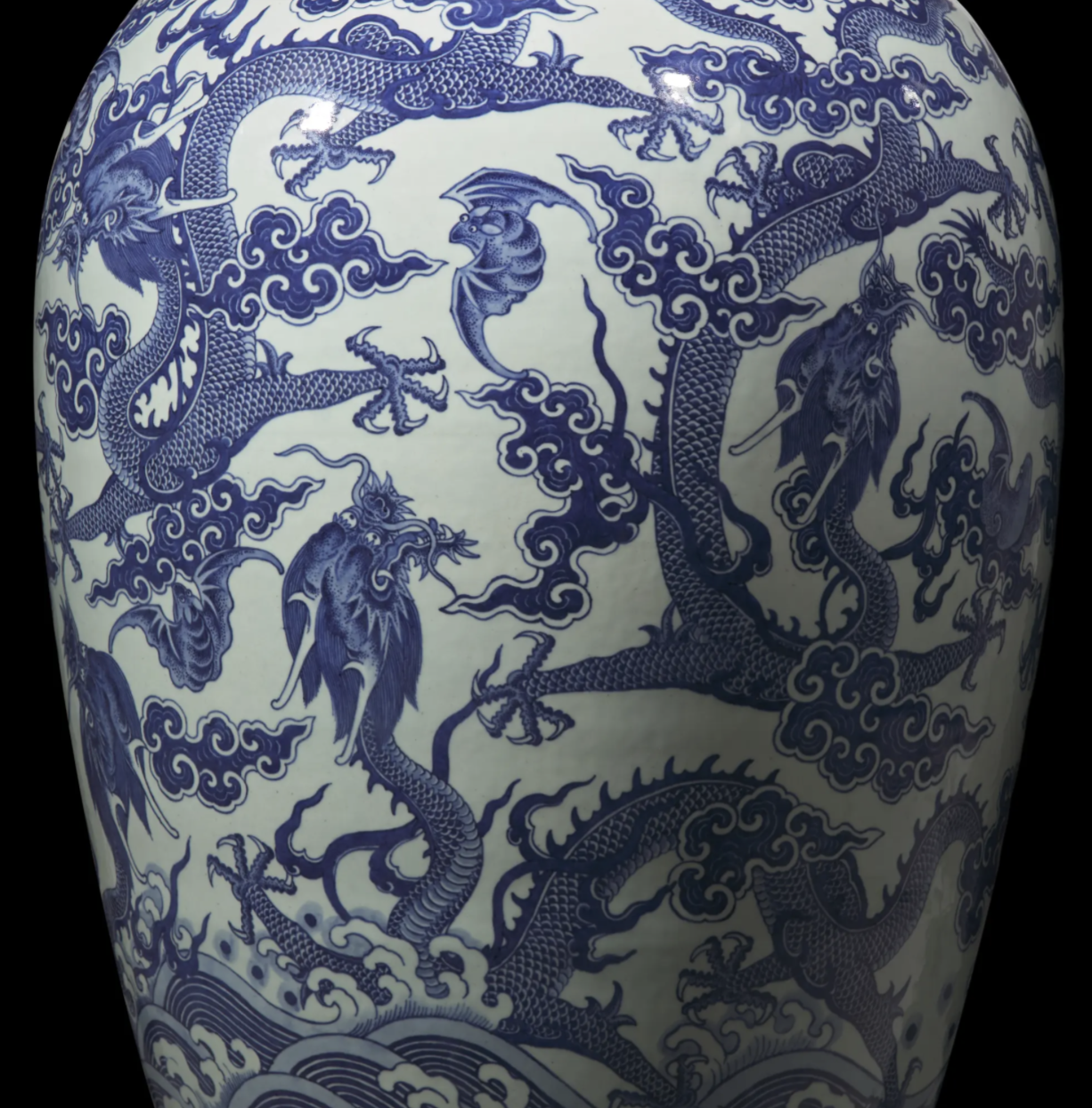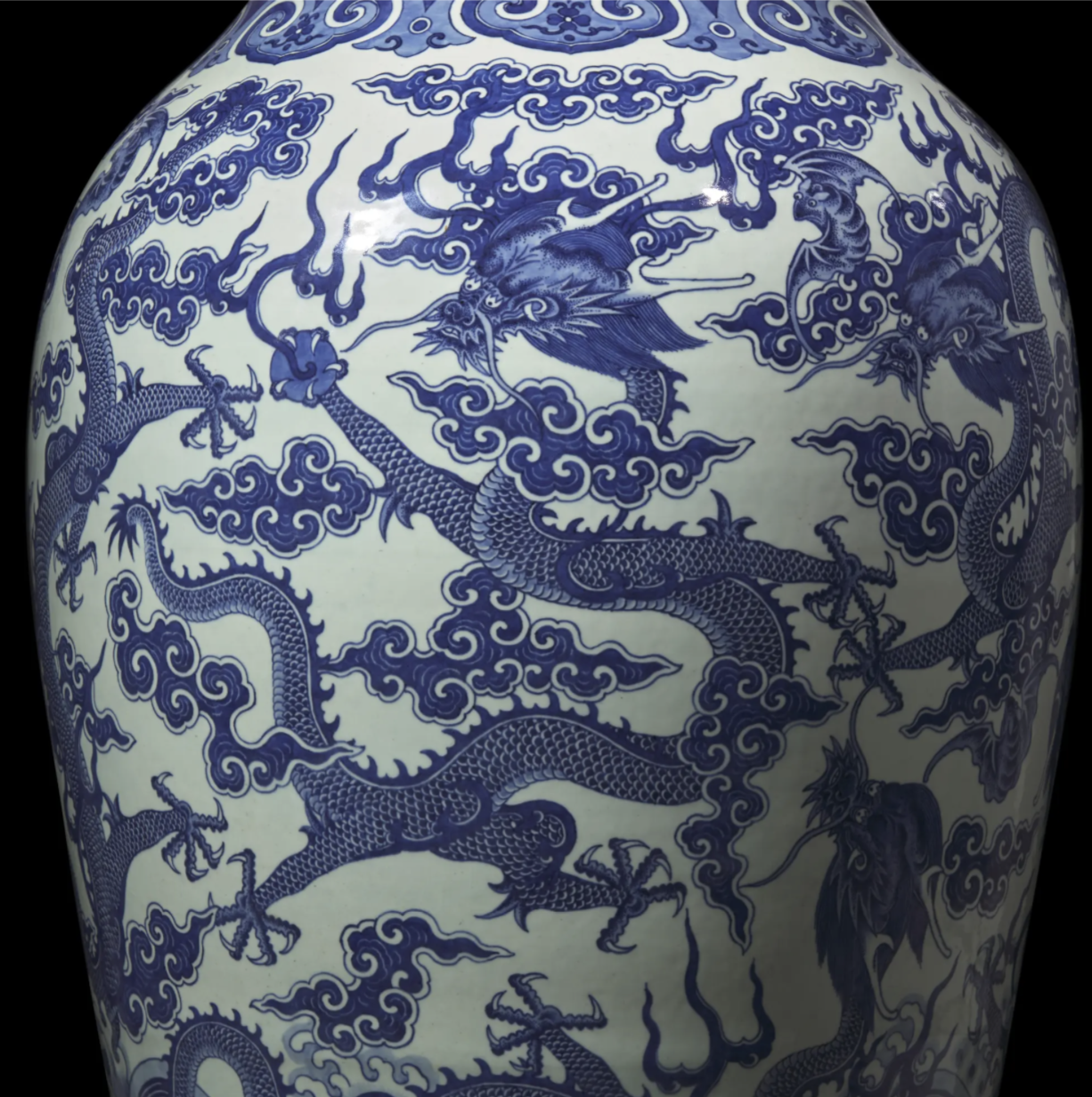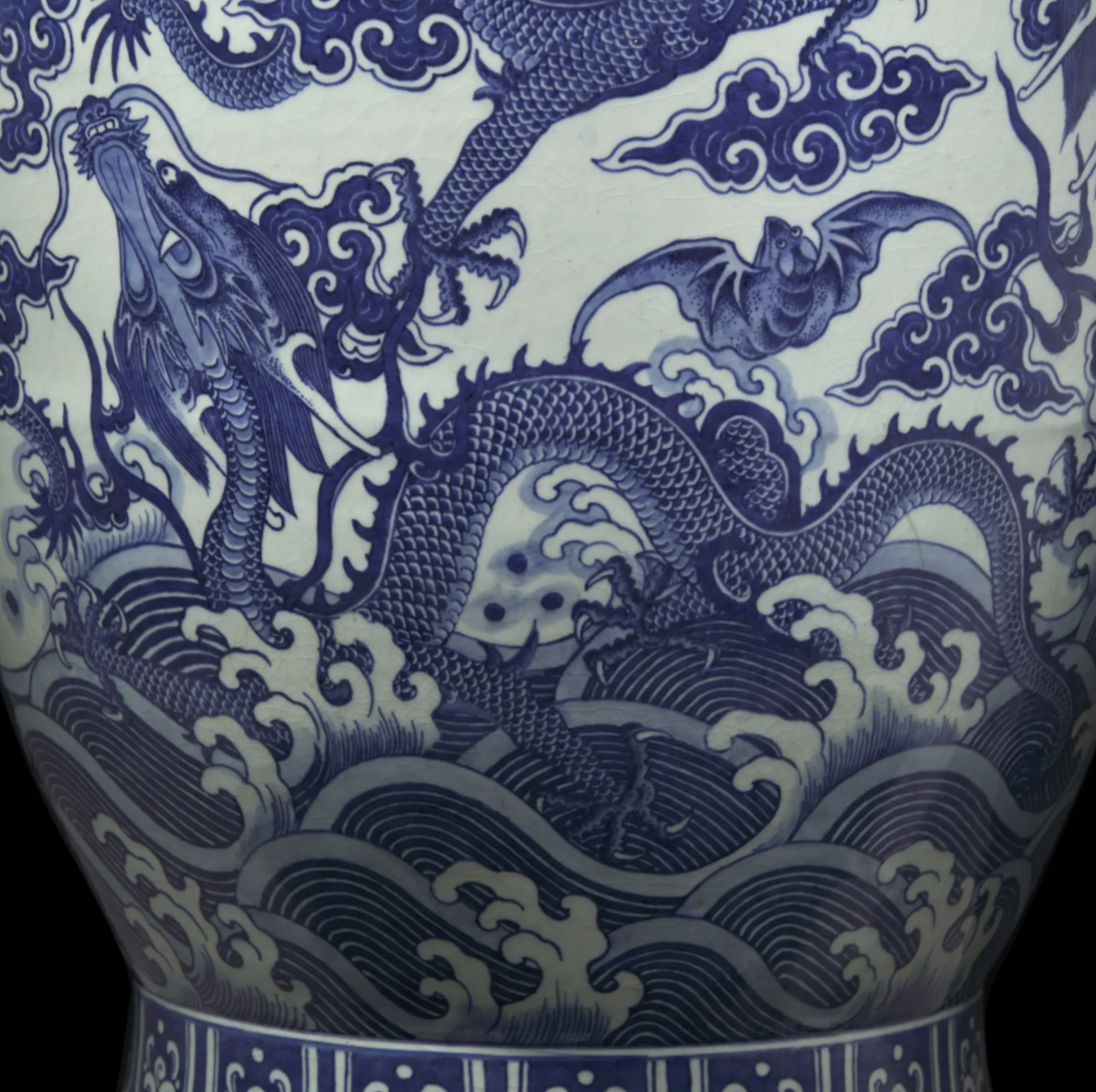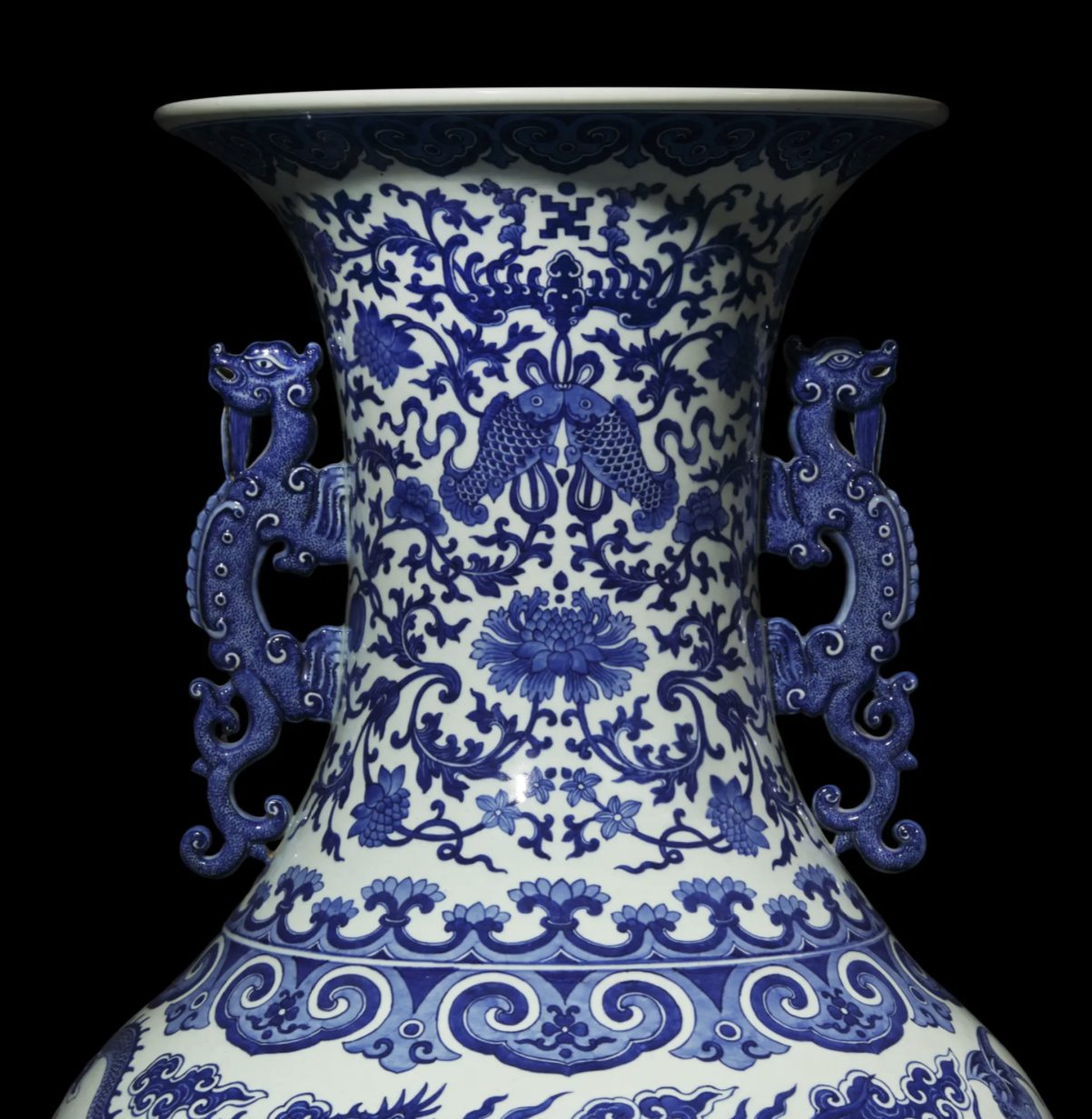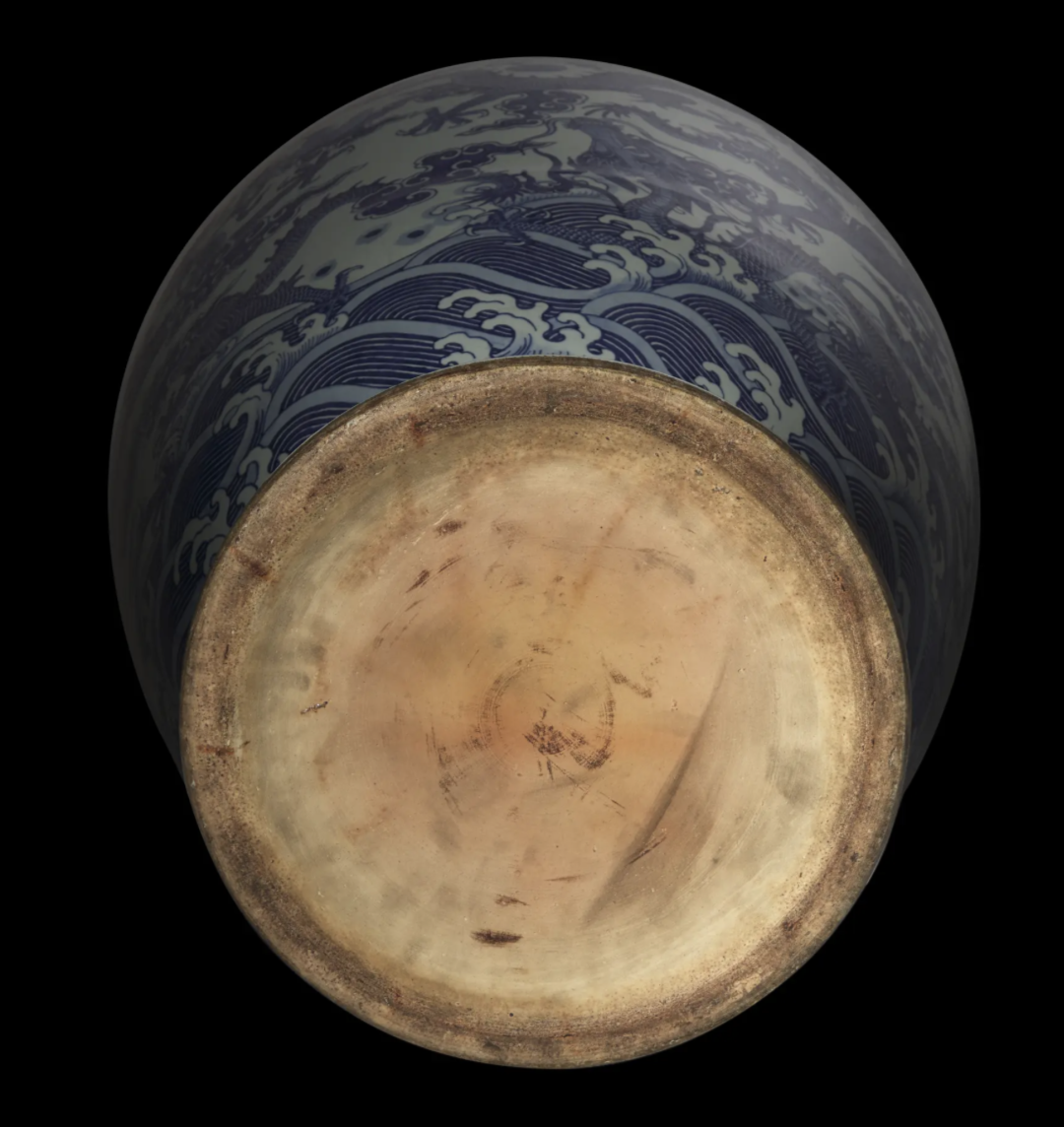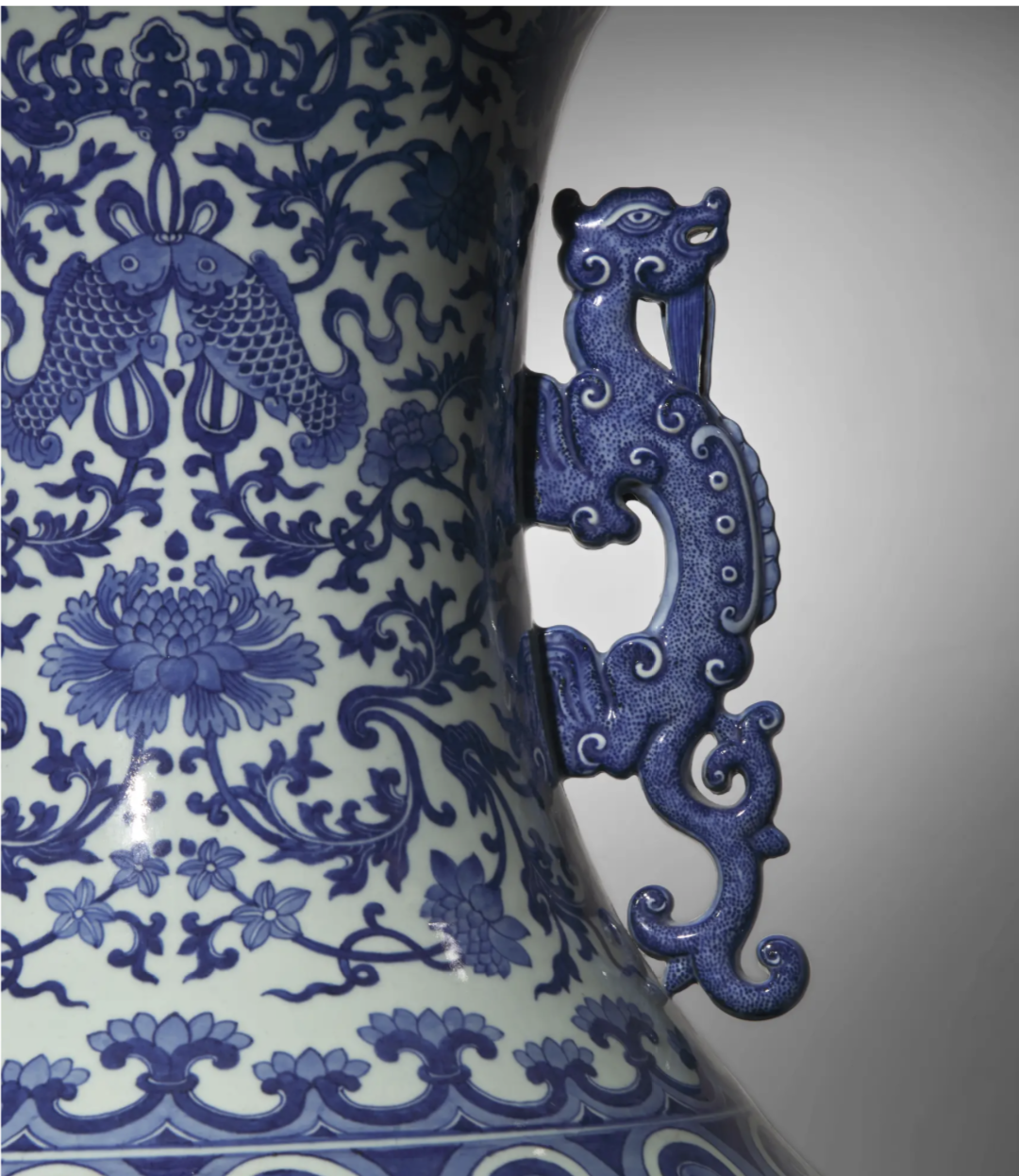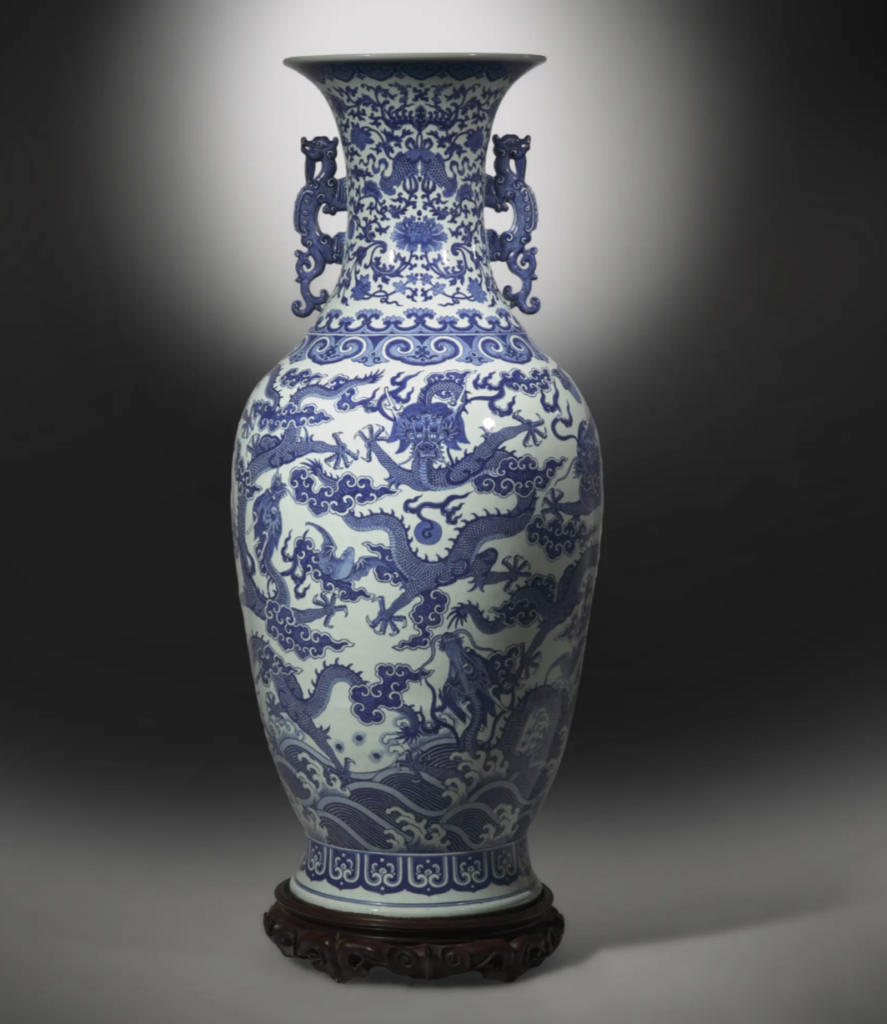
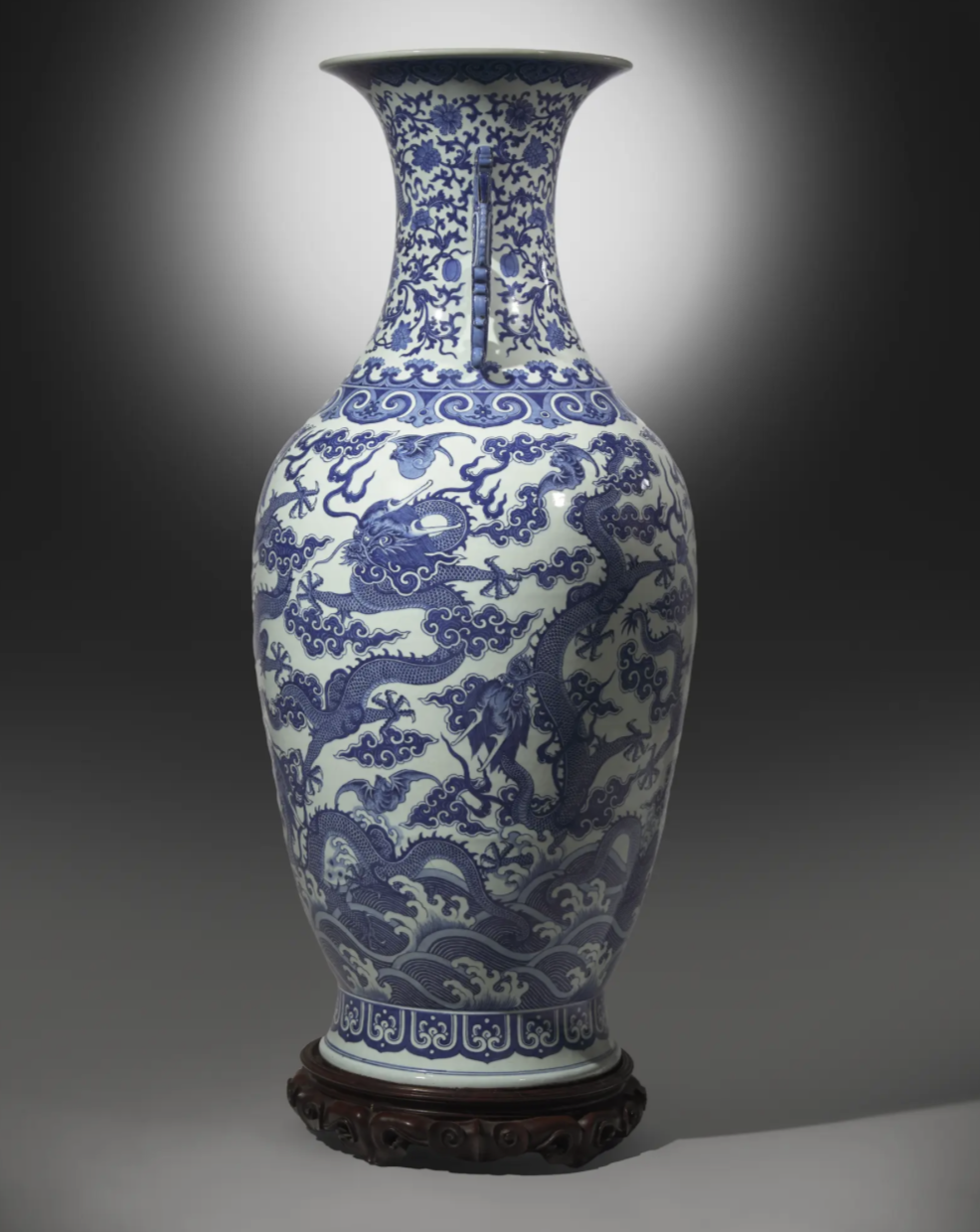
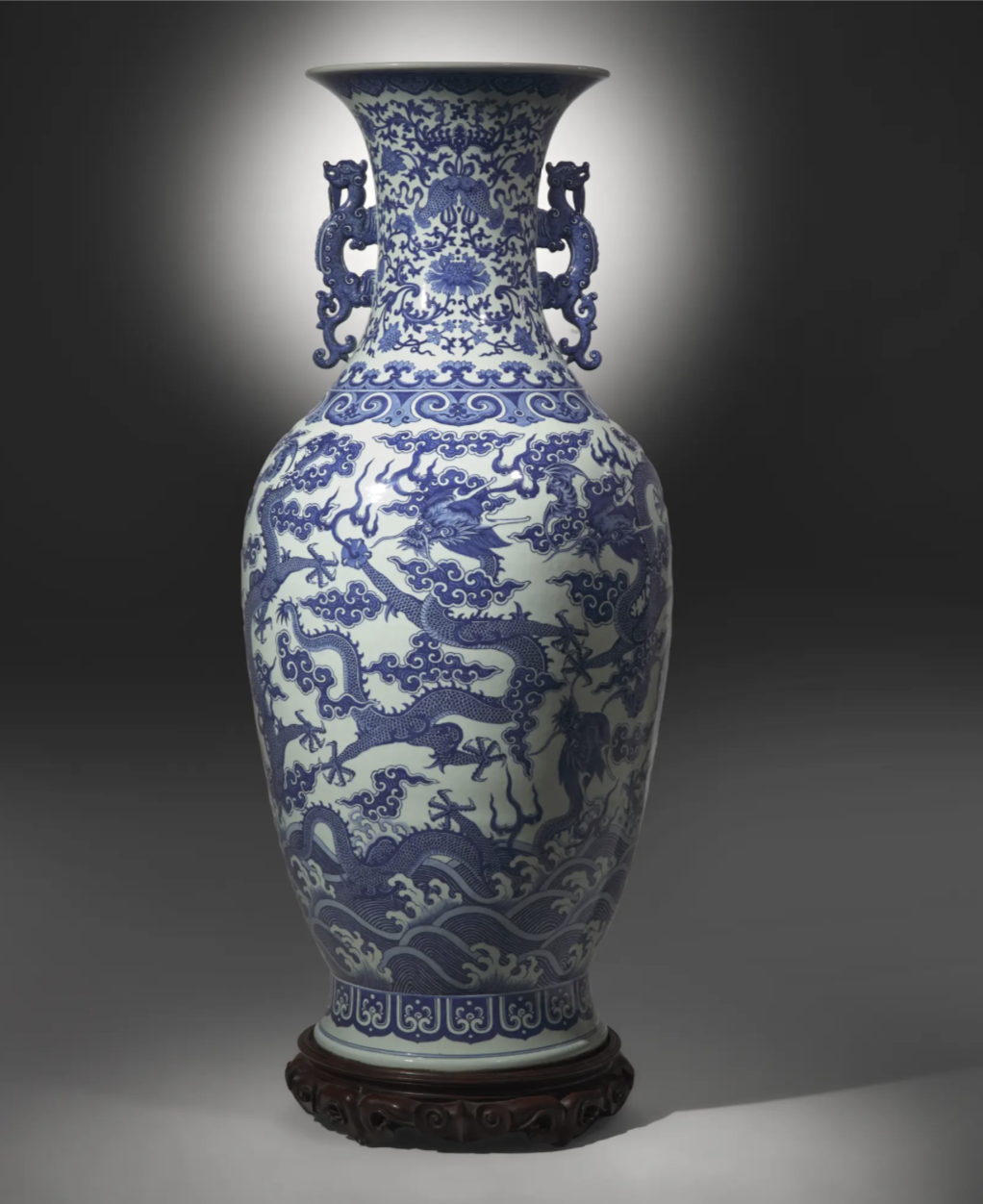
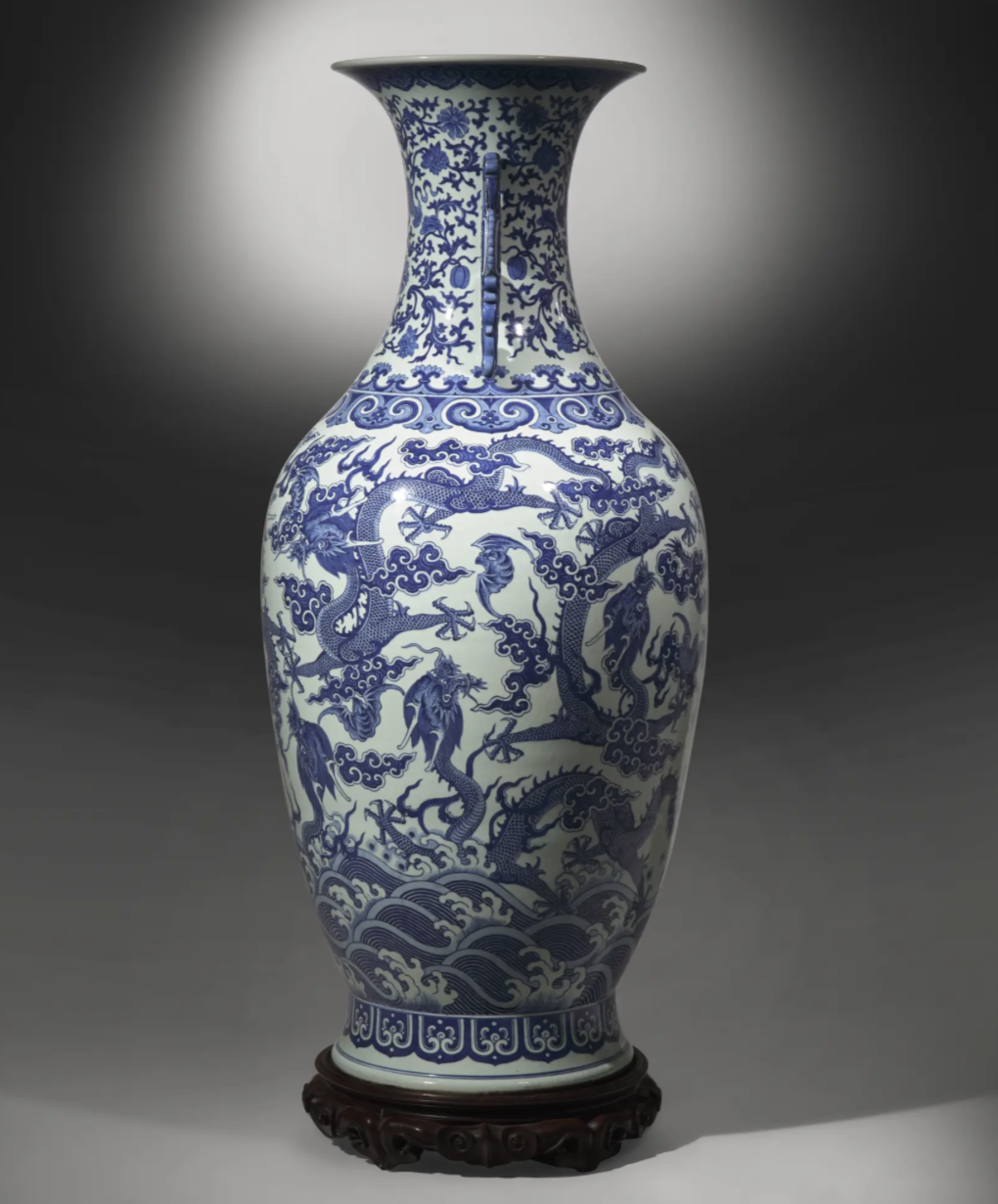
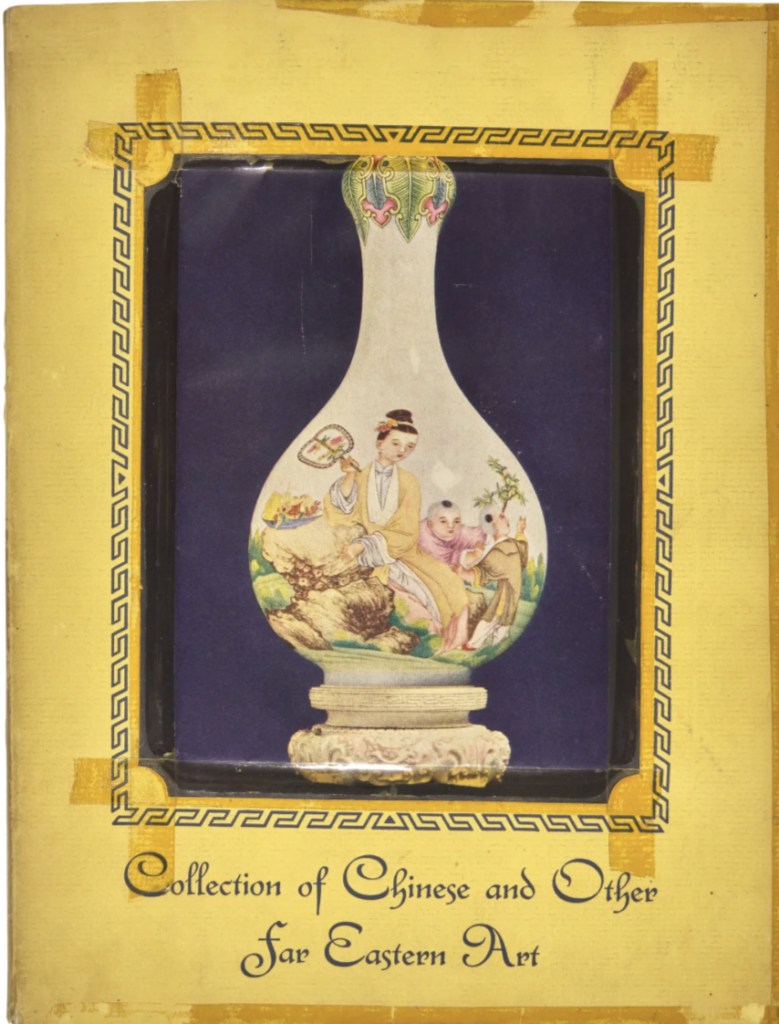
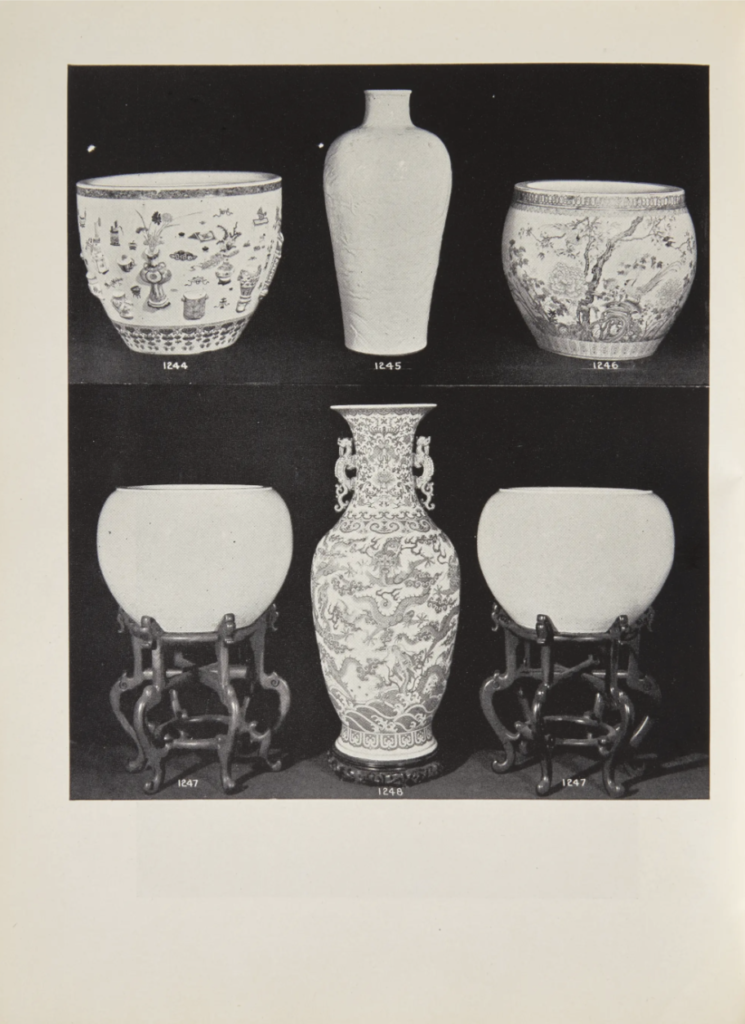
Of imposing scale, the body of slender baluster form, rising from a slightly spreading foot, with applied scrolling archaistic dragon handles at the neck, the body painted with a wide band of nine five-clawed dragons and numerous bats amongst cloud and flame scrolls, the central dragon on one side encircling a flaming pearl, the central dragon on the reverse grasping a pearl in its claws, above other dragons emerging from breaking waves, all below a wide band at the neck depicting a wan symbol, a stylized descending bat with twin fish suspended from a ribbon, peony, lotus, and other stylized blossoms on a fruiting melon vine, below a narrow band of ruyi heads at the flaring rim, echoed by a broader border at the shoulder, and a band of lappets above the foot, the unglazed underside raised on a low foot ring; carved wood stand. Accompanied by a copy of The Yamanaka & Company, Inc., 1943 catalogue in which the present vase is illustrated.
Dimensions: 127cm high.
Provenance: Yamanaka & Company, Inc., New York, Boston, Chicago.
Charles and Aline Anderson, Hamburg, New Jersey.
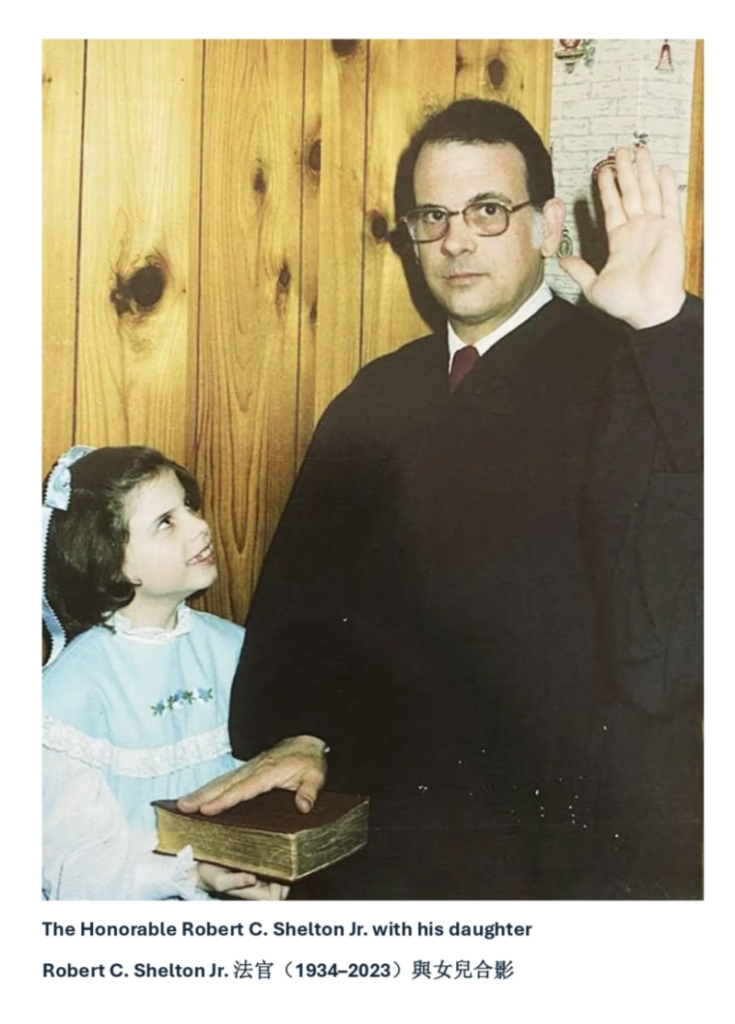
The Honorable Robert C. Shelton Jr. (1934-2023), acquired from the above November 1969, thence by descent.
Sold on behalf of an American client at Freeman’s New York, 18 September 29026 (lot 286) for £1,036,800 (Estimate $40,000-60,000).
Essay:
Qing dynasty vases of this monumental size and exceptional quality are extremely rare and would have been very challenging to produce and successfully fire, particularly as this vase was made in three separate sections luted together before firing.
The treatment of the central dragon is very similar to that seen on Imperial moonflasks from the Qianlong period, with a large frontal-facing dragon such as that found on the large Qianlong mark and period doucai example, with elaborate scrolling archaistic dragon handles, sold at Christie’s, Hong Kong, May 30, 2023, lot 2903. The depiction of an enlarged frontal dragon symbolizes the emperor, and beneath it is a smaller, five-clawed dragon, which is rising out of breaking waves. The smaller dragon represents the heir apparent and appears to be looking up at the larger dragon. This decoration is generally known as ‘The Emperor instructing the Crown Prince’, or ‘The [Eastern] blue dragon teaching his son’ (Canglong jiuzi), and it appears on only a small number of Imperial porcelains. While the dragons on the present vase are all of similar scale, the treatment of the subsidiary dragons emerging from the waves and looking up to the central dragon implies this subject.
The dragon (known as long or loong) is a legendary figure in Chinese culture, usually depicted as a snake-like creature with four legs. They have traditionally been associated with control over water and the weather. During the Tang dynasty (618-907 AD), emperors wore robes with dragon motifs as an imperial symbol. On ceramics, dragons have been depicted from the Neolithic era, but it was not until the Song dynasty that the dragon became the exclusive symbol of the Emperor, with a decree passed by Emperor Huizong (1082-1135) forbidding its unauthorized use. Its use was further refined during the Yuan dynasty, where the depiction of the horned five-clawed dragon began to exclusively represent the ‘Son of Heaven’ and four-clawed dragons were to be used by princes and courtiers.
The motif of nine dragons has long been a reference in Chinese culture to the Emperor and his sons, and is also referenced in the saying “The Dragon has nine sons, and all are not the same”, Long sheng jiu zi, ge bu xiangtong, where it is recognized that one’s children have differing talents and skills. Such sentiments have been embodied in monumental ceramic form since at least the late 14th century, illustrated by the famed Nine Dragon screen wall in the compound of the Palace of the Prince of Dai, son of the Hongwu Emperor, in Datong (Pingcheng). Screen walls such as this inspired the only two other surviving tilework screens of grand scale, both Imperially commissioned in Beijing during the 18th century. The first of these was created for the former Imperial gardens in Beihai Park, circa 1756; the other is found before the Palace of Tranquil Longevity, Ningshou Quan Gong, built as the “retirement” palace for the Qianlong Emperor in the first part of the 1770s.
This theme of nine dragons depicted in multiple poses can be seen on large Imperial blue and white vases of the Yongzheng and Qianlong periods. One example of this, an extremely rare Yongzheng mark and period tianqiuping (“heavenly sphere” vase) was sold at Christie’s, Hong Kong, May 2, 2025, lot 802. The dragons on this vase are finely painted with great attention to detail, and the flame scrolls and the swirling waves express a high degree of movement and energy. In addition, the dragons include one winged dragon just above the waves, and another showing the underside of his chin. This degree of inventiveness in the depiction of dragons may be seen in the Kangxi period, as depicted in the blue and white dish sold at Bukowski’s, Stockholm, December 11, 2020, lot 594. It is quite likely that this would have been painted at one of the private kilns at Jingdezhen, which allowed for a greater degree of creativity and experimentation with designs than the imperial kilns. However, one does see this type of depiction in the Imperial blue and white nine dragon tianqiuping vase mentioned above.
The design of the wan symbol (ten-thousand or “limitless”), bat, twin fish, peony and fruiting vine at the neck of this vase form a rebus. The descending bat (fu dao) represents the arrival of good fortune and blessings, the twin fish (shuang yu), harmony and abundance, the peony (mudan), wealth and honor, and the melons, with their numerous seeds, a wish for numerous children. Together they form a powerful visual message of great happiness and abundance.
In terms of comparisons, no direct examples have been located, but a smaller (27.5 in.) Yongzheng seal mark and period vase without handles can be seen in the Qing Court Collection at the Palace Museum, 新00087847, illustrated in ‘The Complete Treasures of the Palace Museum, Blue and White Porcelain with Underglazed Red’, Geng Baochang et al, Hong Kong, 2012, Volume III, no. 89, p 103. Here the nine dragons are painted on a Ming-style ground of scrolling flowers, with thin bands of breaking waves at the base and at the shoulder. With regard to the painting of the present vase, this is of very fine quality, and this combined with the five-claw dragons and monumental size, points to an Imperial production. However, the stylistic treatment of the ruyi and lappet bands and the breaking waves is in a slightly more linear manner than one might expect in the Qianlong period, which suggests a date after the Yongzheng and Qianlong periods. Compare the ruyi-head border on the lip of the Jiaqing seal mark and period dragon-decorated blue and white bottle vase sold at Sotheby’s, New York, September 13, 2017, lot 22, and the similar border on the extremely rare Jiaqing seal mark and period double-gourd blue and white “Nine Dragon” vase, sold at Sotheby’s, New York, November 7, 2018, lot 70.
The careful yet stylized archaistic treatment of the dragon handles was also particularly prevalent from the Qianlong through Daoguang periods, as may be illustrated by the monumental yellow-ground Qianlong mark and period vase sold at Sotheby’s, Hong Kong, April 7, 2015, lot 3608. Compare also the painting of a pair of handles on a massive unmarked ruby ground vase, dated to the Qianlong/Jiaqing period, sold at Christie’s, New York, September 25, 2020, lot 1596. For another unmarked ruby-ground vase with similarly painted handles dated to the Qianlong/Jiaqing period, see Christie’s, Hong Kong, May 28, 2014, lot 3466. A third unmarked ruby-ground vase, dated to the Qianlong/Jiaqing period, with stylized handles painted in russet brown, and the neck decorated with descending bat, chime, lotus, endless knot and twin-fish was sold at Christie’s, New York, September 17, 2010, lot 1420. This treatment of decorative motifs found on the necks of these four vases also closely relates to the motifs and treatment of the neck of the present vase, such as the ruyi-head border to the lip, and the complex composite pendant surrounded by symmetrical floral scrolls, further supporting a date from the late 18th to the first part of the 19th century for the present vase, and demonstrating that not all vases of Imperial quality and dramatic scale received reign marks during this period.
Robert Bradlow
Illustrated:
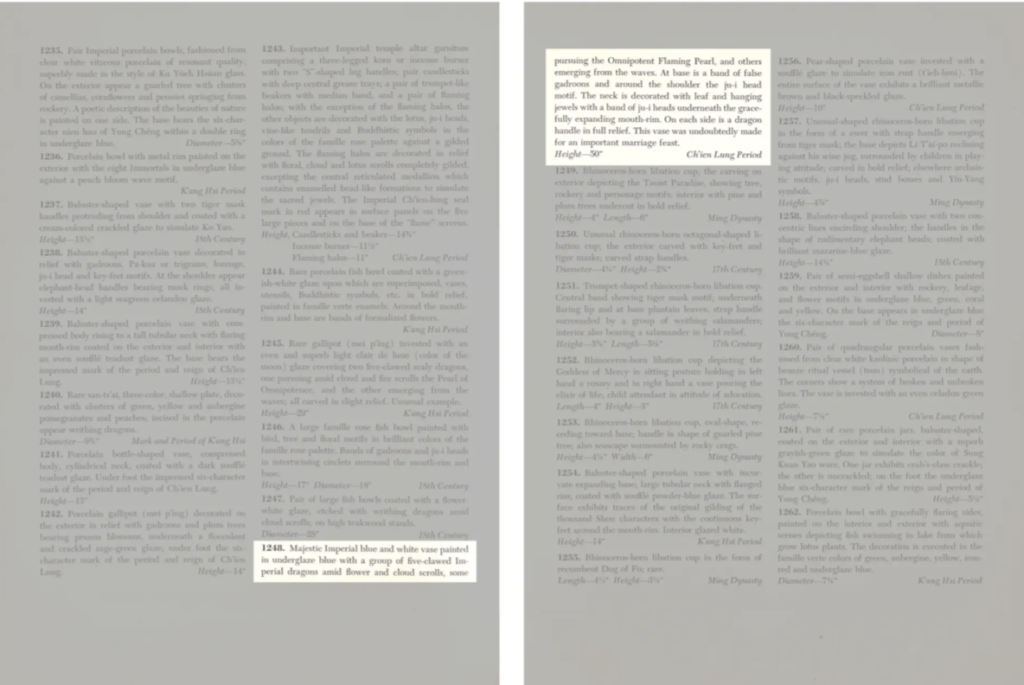
Collection of Chinese and Other Far Eastern Art Assembled by Yamanaka & Company, Inc. New York: Yamanaka & Co, 1943, no. 1248, catalogued as Qianlong period.
Chinese and Other Far Eastern Art. New York: Apollo, Poughkeepsie, New York, 1988, no. 1248.
A Qing Dynasty Vase, A Father’s Love, and A Daughter’s Quest
The Honorable Robert C. Shelton, Jr. (1934-2023), son of Helen and Robert C. Shelton Sr., was raised in Franklin, NJ. He is survived by his son, three daughters, many grand and great-grandchildren, and his pride and joy, a magnificent 50-inch blue and white Qing dynasty “Nine Dragon” vase.
Judge Shelton wore a variety of hats throughout his life: son, Husband, Father, Grandfather, Attorney, Prosecutor, Assemblyman, Superior Court Judge, World Traveler, Photographer, Ham Radio Operator, Car Enthusiast, Pilot, Opera Aficionado, and Collector of Chinese Antiquities, inspired by his magnificent vase.
Charles (d. 1966) and Aline Anderson, well-known antiques dealers in Hamburg, New Jersey, were clients and friends of Judge Shelton. The Judge had long admired his friend Charles’s most beautiful treasure, an imposing blue and white porcelain vase, painted with nine five-clawed dragons. He was awestruck by its size and the beauty of the dragons and enchanted by the history chronicled by Mr. Anderson, a story of the imperial household, a wedding, and symbols of good fortune, happiness, and longevity. Mr. Anderson was well aware of Judge Shelton’s passion for his porcelain trophy and had instructed his wife to sell it to his good friend the Judge, should he be called from this realm ahead of her. In 1969, she fulfilled her husband’s wishes.
Upon acquisition of the vase, Judge Shelton had one conundrum. How did one move a rare porcelain treasure of 50 inches in height, a diameter of 23 inches, and a weight of 200-plus pounds? Judge Shelton’s time as a volunteer fireman inspired him to request an ambulance transport with the promise of a generous donation. Who better to handle his newfound love with care and precision than the men and women who had taken the oath “To first do no harm”. So the vase was strapped to a stretcher and moved from its home in Hamburg, New Jersey to Judge Shelton’s law office in the neighboring town of Franklin.
In the mid 1970’s the Judge decided to move the vase to his home in Ogdensburg, New Jersey. The sitting room in the Sheltons’ home was redesigned to complement the vase. The walls were covered in cerulean flocked wallpaper, the sofa reupholstered in the same tone. Blue and white Chinese vases were converted to lamps, and a Ming bowl of similar color sat on a marble table. An Oriental carpet was purchased to complete the room.
The vase remained the cornerstone of the room until the late 1990’s and, perhaps most surprisingly, survived the five Shelton children without a scratch or chip,
It was in this room that Judge Shelton and his wife entertained friends and colleagues, and he inevitably spent a portion of each soiree regaling his guests with the tale of his treasure in a deep, resonating basso voice: “…originally commissioned as a wedding gift to a member of the imperial family, as noted by the various symbols represented in its artwork.”
In the 1990’s, the Judge and his wife separated. She maintained the home; he maintained the vase. A new room was designed to showcase his masterpiece. The Judge was getting older, and the vase, which had been a forbidden fruit to his children, now became a time capsule for his granddaughter, who was more treasured than his priceless vase.
While traveling with a son to Australia, he happened upon an article written by a young auction house specialist, Robert Bradlow, titled “Interesting Finds and Fakes in Chinese Porcelain”. The article included a photograph of an Imperial vase with a dragon that closely resembled his. The Judge wrote a letter to the young man, who surprisingly wrote back. The Judge had all intentions of continuing the correspondence, but life had other tragedies to deal with, including his own failing health.
The Judge passed peacefully surrounded by his remaining children and grandchildren in 2023. He bequeathed his vase to his daughter, with the understanding that if its importance were recognized, it may be sold to benefit the family. Thus began his daughter’s research into the vase’s provenance and where divine providence intervened. She began reading through her father’s file on the vase and following any potential leads to its origins. This included reconnecting with Robert Bradlow, decades after her father’s original correspondence.
She shared the reputed history she had learned from her father. Upon acquiring the vase, Judge Shelton had found a crumpled piece of paper that stated the vase was brought to the U.S. by Cornelius Vanderbilt. There were also references in her father’s file to various Rockefeller and Vanderbilt estate auctions; they followed up on these leads to no avail.
She spent hours each evening researching names which, in turn, led to more names, including Yamanaka & Co., storied purveyors of Chinese treasures. One evening she came across a 1943 catalog, “Collection of Chinese and Other Far Eastern Art Assembled by Yamanaka and Company, Inc.” She began scrolling the 256-page catalog of 1683 items. And then, on page 168, her hands began shaking…THE VASE. Item 1248.
Instantly she was transported to her childhood home, her father standing proudly in front of the vase, mesmerizing his guests with his tale and description, as the catalogue stated“…This vase was undoubtedly made for an important marriage feast.”, printed words that echoed her father’s story told so many times over the years.